
Gypsies in a rugged land: Ladakh
Travel with us to Ladakh in a plane, gauge the locales on a bike, climb down halfway in a ramshackle of a car and head back to base by hitchhiking on a bus.



We decided to circumnavigate Leh at the fag end of the tourist season to do a recce on the most enigmatic land of India to dodge monkey capped zombies and sightseeing selfie freaks. But the paragons of the seventh deadly sin that we are, the easiest mode of transport that beckoned to us like the voluptuous Jessica Rabbit was an aeroplane. We woke up at an insane morning hour of the tethered day and headed to the colossal third terminal of IGI – cribbing, swearing, loaded, excited and full of sinister plans to summon an early death...
The flight
Most adventure junkies have no idea that travelling from Delhi to Leh – from 700 feet to a whopping 11,000 – in a matter of 90 minutes by flight is as challenging and toll taking as reaching there by road, only for different reasons. One, there are only early morning flights to the northern most tip of the Indian airbase, which means you have to be at the airport really early. Two, gorgeous as it is, the stretch between the security gates and the runway at T3 (Indira Gandhi International Airport, Delhi) is like the Siberian wasteland – you keep walking and Moscow is still far away. Three, as soon as you walk out of the compression-controlled aircraft at Leh the low pressure hits you like a tonne of bricks. People start freaking out at their bleeding noses and nagging headaches, which are common. It often takes a full day for your body to fully recover from the atmospheric shock. Four, when your biker friends come back from a trip to Leh with amazing pictures of their road trip, all you have to show them are few topographical representations of the landscape (beautiful, though) that you managed to click from your irritated neighbour’s window seat in the plane.

Luckily, we by-passed the first three challenges easily but the fourth one was something that a lethal imperative on the Facebook-driven intellects of some of us could not sidestep as easily. A change in the game plan was suggested and sealed readily, but much on it later. I had done the Ladakh ritual almost 10 years back, two among the five of us just a few months ago, and one was an absolute virgin. It is to be understood that throughout this narrative, without me mentioning it anywhere specifically, he would look at everything around with the amazement of a new born.
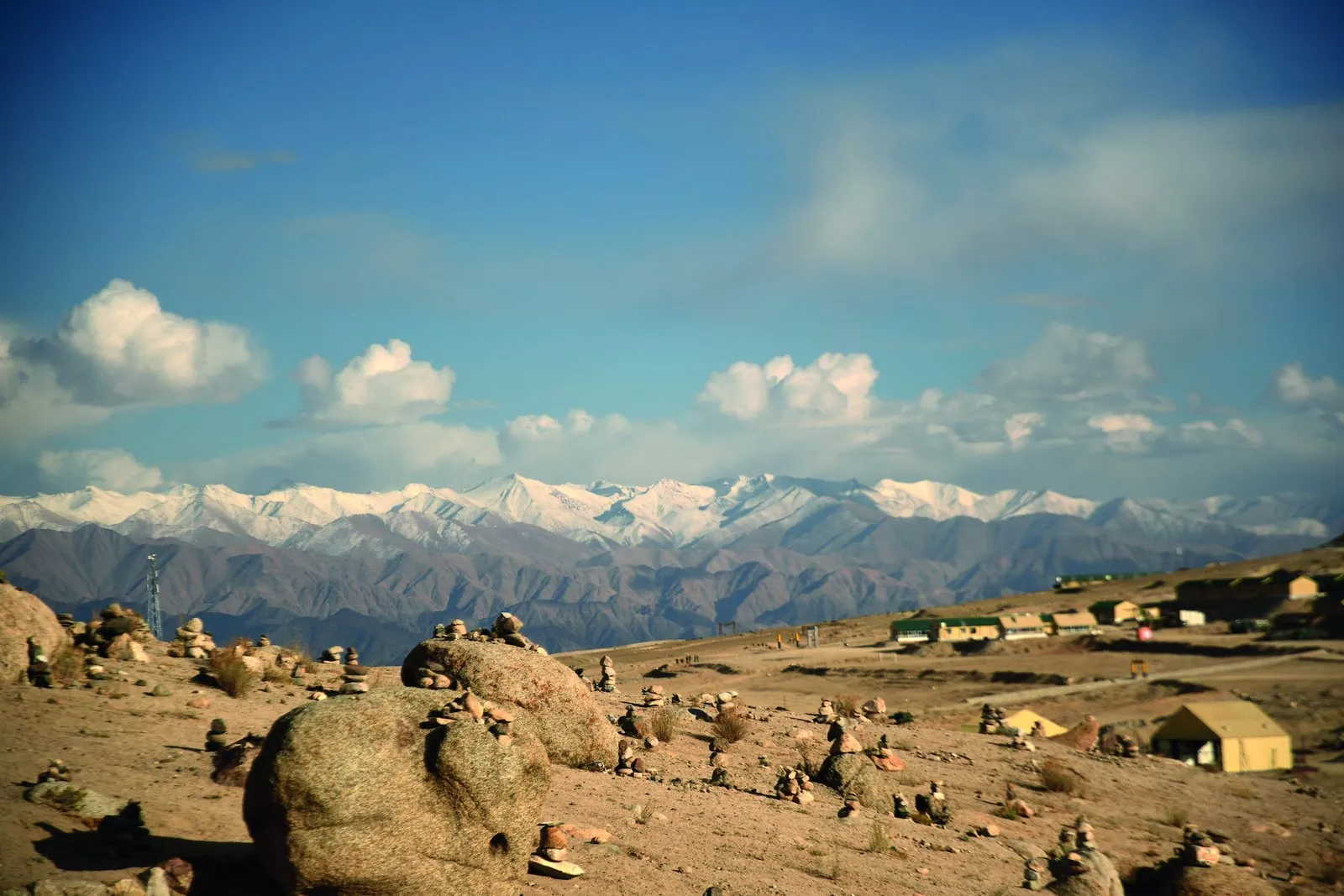
During the trip, we would defy several physiological rules, including elevation sickness and short breathing, despite a tight and rigorous routine. We checked in to our hotel, around two and a half kilometres from the airport and hogged like bulimic mavericks. The next three days would be spent in shoots and everything else that had initiated our visit to the mountain desert. And once all that was over the land became our muse, our feet the chariot, our eyes the canvas of a speed painter, and spray-paint hard everything we did!
The local story
Advance bookings or not, Leh has room for everyone. Especially in the off season. There are two major roads: Fort Road and Old Road that are basically festoons of hotels, guest houses and homestays, of varying status and budgets. Just walk in, enquire, compare and fall asleep in the one that makes your pocket and rear side happy. Most hotels serve popular North and South Indian food in their restaurants as that’s what tourists are most comfortable with. But if you want the real taste of Ladakhi food you must head to the market area, which is full of great options. Essential try-outs: The Himalayan Cafe, Gesmo German bakery, Summer Harvest, KC garden cafe, Tibetan Kitchen. A little gem of a place right next to the big mosque in the main market is Lala’s Art Cafe, which is nothing bigger than a pahadi mud house but gives you a warm welcome and an overhead view of the Leh Palace from the rooftop.

Most cafes and restaurants don’t have licenses to sell hard liquor and you may have to do with just beer, which is available almost everywhere, even in bakeries. Our hardened palates couldn’t fathom a chilled drink on 5 degree evenings, and we resorted to the standard tipsy-prescription, Boodhe Baba. If your muscles don’t threaten of deadly repercussions from walking, do as I and my partner in the wandering crime did – walk from your hotel to the market, finish breakfast, head to Leh Palace, trek to Shanti Stupa, and continue to tread on to reach Sankar monastery (which, by the way, like all other monasteries in Ladakh, shuts gates at 5 in the evening), reach back the market by evening all starved out and order a huge meal. Make sure your partner doesn’t stop midway to feed random dogs, lest you may just miss a glimpse inside the gompa.
Just saying.
The bike
Every place in the world has a signature, like Goa isn’t over unless you break your pelvis, high on substance of your choice, on the dance floor; Kerala without the backwaters; Delhi without the Red Fort, and so on... In the same line of reasoning, a trip to Ladakh isn’t over unless you glide over the flush roads on a two wheeler. No speed breakers disturb your speed and the wind is just perfect to sprinkle energy all over you.
We rented one 500cc bullet each and with the base grumbling of its engine set on a ride without purpose on the Kargil road. It’s very easy to rent a bike in Leh. All you need is your driver’s licence and a thousand and half to spare for the day. During the off season it is also easy to negotiate the prices with the rental shacks. There are four options for a road trip in and around Leh: Manali road, Kargil road, the road to Nubra valley and the road that takes you to the iconic Pangong Tso lake. Among these the best in condition is the one that we chose, however there are beautiful monasteries (Shey Palace, Thiksey) on the Manali road, the world’s highest motorable road at Khardung La on the road to Nubra, and of course the highest lake in India at Pangong.
While on the road, amid almost zero traffic (yes, we compare everything with Delhi), some 20 kilometres from the city we saw a shrine-like structure very different from a monastery. Several cars were parked on the opposite side of the road and thanks to our ignorance or dependence on clichés we were shocked to learn that it was a Gurudwara – Gurdwara Patthar Sahib. We resumed our journey after a fleeting halt and around five kilometres short of Nimmu found a hairpin bend on the left, diverting a road to the river level. If you’re on this road make sure you take this turn or you’ll miss a beautiful confluence of two major rivers of the region, Indus and Zanskar, called Sangam. The two rivers are so distinct from each other that you can easily tell the green shades melting into blue. If you haven’t rafted on a glacial river as high as this before, this is your chance to get that ticked off your bucket list. But a warning – the water is extremely cold, no matter what season you go in.
After a romantic break at Sangam we rode on through Nimmu, Phayang and Saspol, only to stop briefly at a bridge that leads to a serpentine uphill ride to Alchi. This was probably the most crowded place on the stretch and those who formed the assemblage – gawking at us – gave us a minor heart attack. It was a band of army jawans, armoured et al, in sweaters a shade brighter than the regular Indian army uniform. What invoked more than just a slight horror were little Pakistani flags on their sleeves. A small troop of the enemy had made it so effing deep inside the border and were staring at us nonchalantly!!! The thunder was stolen and our breaths resumed by one of them who told us that it was an ‘Indian’ crew of a movie, waiting for the ‘Indian’ guy who was directing it, about the Afghanistan-Pak trouble. A moment of relief!
Once up the hill, the road to Alchi takes you to a narrow pavement-like thoroughfare to a small settlement in a perfect valley surrounded by high mountains. You can feel the temperature difference as you ride down towards the Alchi monastery, which is moderately warm due to an absence of the quintessential evening chilly wind of Ladakh. A narrow pedestrian lane leads to the monastery, behind which a huge Indus flows with an enormous burble. You can buy souvenirs from the gift shops at the head of the lane. Also, make sure you pay a visit to a beautifully done, casual, home-style restaurant by the name Alchi Kitchen. We did not eat anything here but tasted each variety of tea available on the menu, and were pleasantly satisfied.
The halfway drive
The second half of our tour was reserved for some super adventure with the 18th edition of Raid de Himalaya, one of the top ten toughest rallies in the world. We moved in to another hotel that Maruti – the head supporter of the Raid – had arranged for us as participants in the rally, and waited for other competitors who had already finished a major portion of the race starting from Manali. Next day early morning we’d leave for Sarchu, through Rumtse, Debring and Daat on our ride – the S-Cross. Towards the evening we received news that one of the motorcycle riders in the Extreme category fell 70 feet down in the third leg of the race near Chhatru and died. The adventure had just turned into a terrible nightmare and the organisers had to cancel the Extreme category in toto.

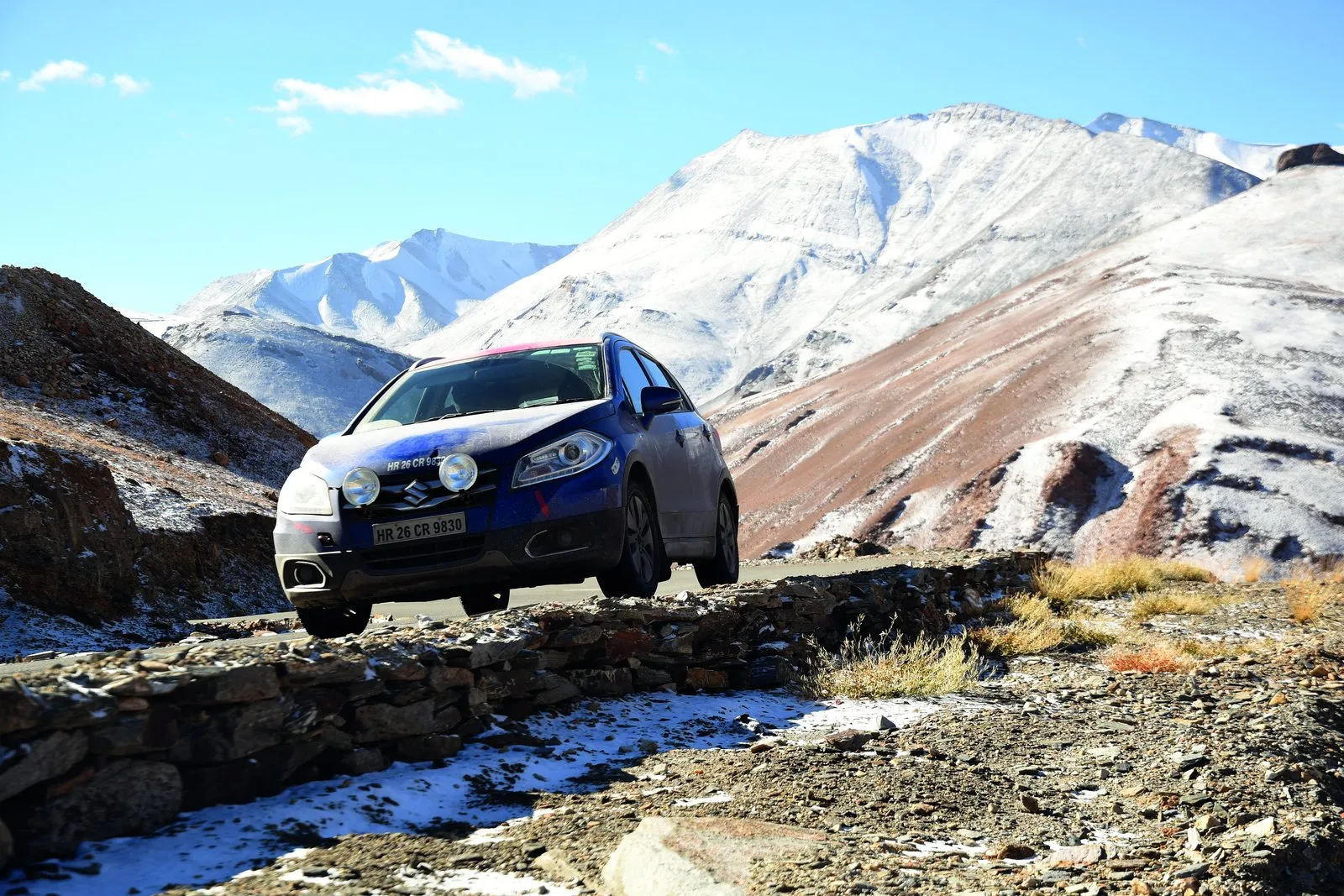
We would anyway have to return to Manali for the final prize distribution, so we got geared up early morning and examined the car we’d travel in. Before going any further, I think it’s my duty to remind you of the importance of the first gear in any vehicle. It’s important, right? It’s something that can’t be done without. But when you see a car rolled up in mud, having traversed through some of the most dangerous terrains in the world, one hardly thinks of that little thing. It’s a beautiful sight, capable to marinate each emotion of yours in pride int the hope of experiencing a (however short) legacy of adventure. As we turned the ignition on it took us over five seconds to raise the speed over 20 kmph in the first gear. And we were thrilled to go.
20 kilometres down the Manali road and the dead pick up of the car was already testing our patience at each dog’s threat to cross the road. The driver who had driven it during the rally – we hope – had done an excellent job on the scoreboard but had royally screwed it for us. There were over 450 km still to go and if we wanted to reach Manali before midnight (which we did), there was no turning back. The group leader – aka our driver, aka our editor – managed to pick speed and keep it high with a warning call instead of breaks at every bump or uneven patch. If this ever happens with you and you happen to be anywhere near 6 feet tall, my advice is to keep your head permanently ducked down, like they show in head-hangingin-shame emojis or be prepared for some serious head banging.

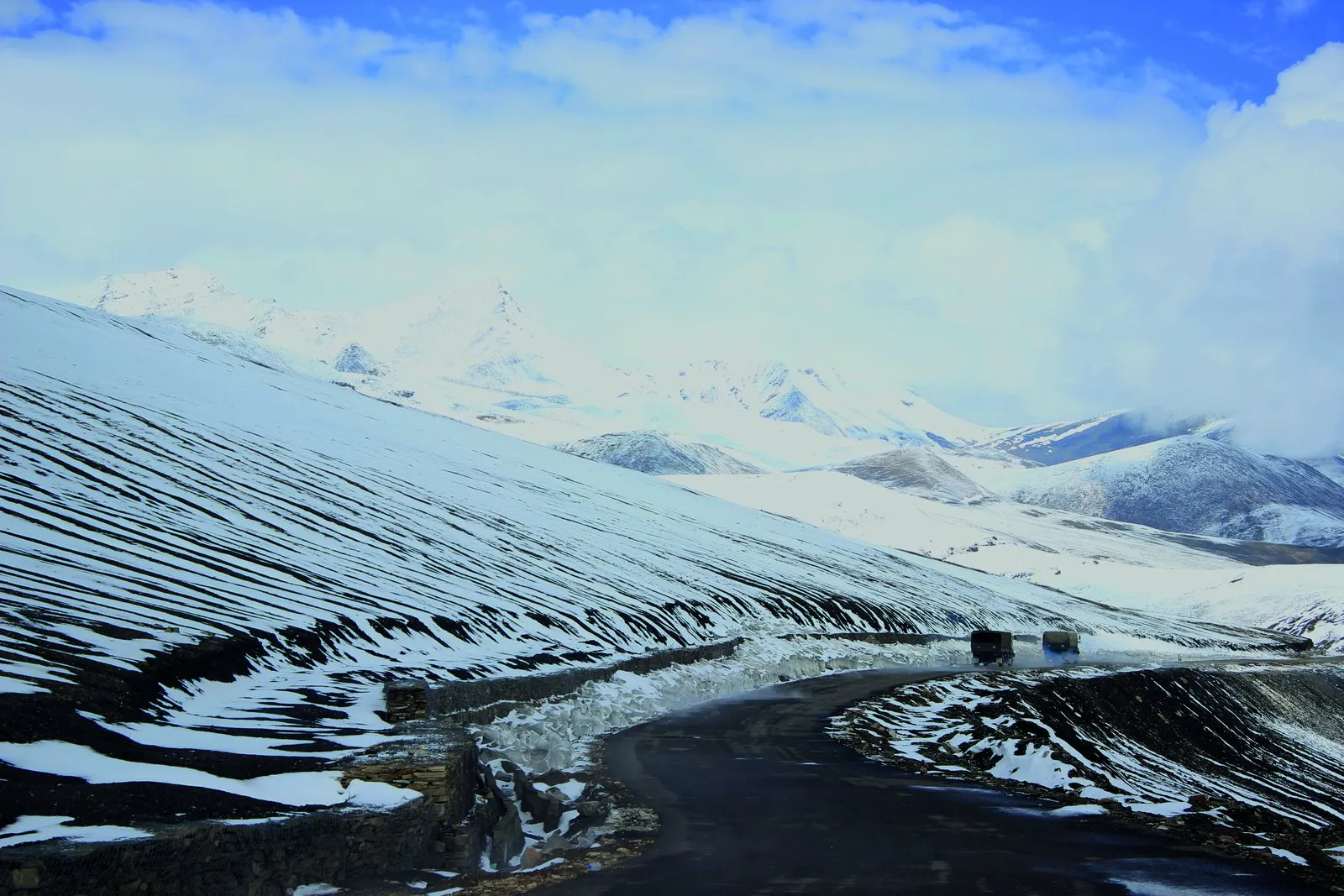
One of the highest passes in India that allows cars is Tanglang La (17,585 ft) and probably with the best roads too. No matter how bright the sun shines, it always has a layer of snow laid gracefully flat to welcome any traveller looking for some thrill. Click as many pictures as you like but there’s hardly an angle that does justice to what you see with your eyes. We stopped the car and jumped outside in excitement only to realise that the sun was reduced to a high power bulb with no heat whatsoever. The car’s screen was displaying a temperature of minus 5 degrees and we felt numb with all the following reasons in the same order: beauty of the Himalayas, Sun’s capability to switch personalities, minus 5 degrees temperature, and our exposed hands that held our phones for selfies.
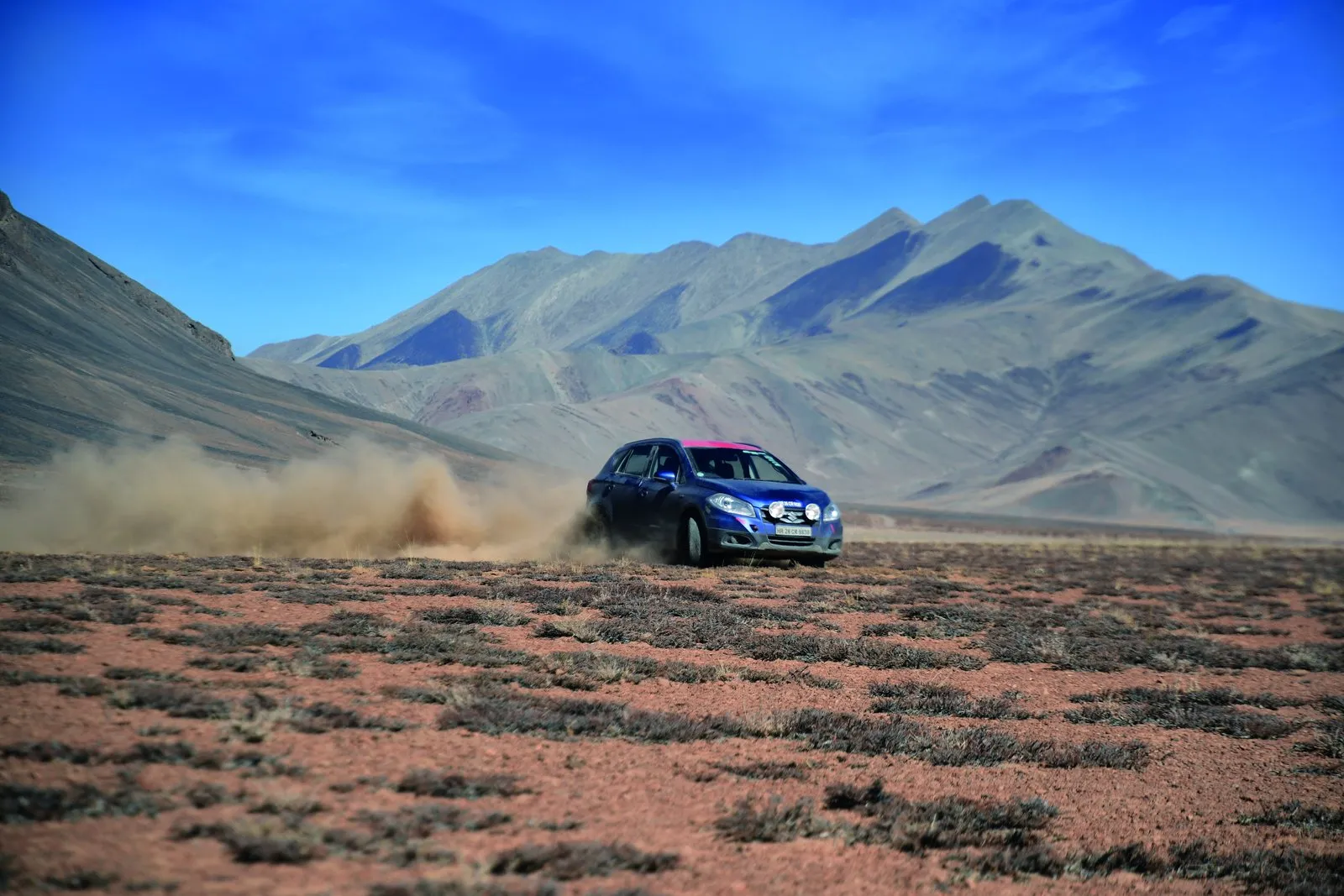
Right in the middle of the 87 km stretch between Tanglang La and Lachalang La, at Pang, lies an enormous piece of flat land culminating into a deep cliff. I don’t think anyone on the road can resist the charm of Pang. We were craving for our share of adventure in the rally, which was now sadly over. So, our group leader decided to put his long association with the mechanical engine of a car to test by pushing our gem of a ramshackle into a few drifts. (Check out the video of Hari Govind Nair drifting an S-Cross in Ladakh at www.fhmindia.com). By the time we got back on road, our body pores were releasing fumes of adrenaline and all the other hormones you keep reading about these days. After several rough patches on the road and our moods, by the time we reached the base of the famous Rohtang pass, the sun had already set and it was beginning to get dark. The two sides of the Rohtang pass are like Sita and Gita – two identical twins with diametrically opposite personalities. The upward climb is absolutely broken, while the one on the Manali side is as smooth as Teflon. We spent five minutes outside the car at the top, shivering like never before, under a sheet of bright stars against the darkest sky ever. Satisfied. Manali would be an easy ride from here.

Full circle on a bus
Final day of the journey back home arrived and we still had little vibrations of the entire excursion ringing in our ears like singing bowls, transforming the nature of the tour into something like a holy pilgrimage. We couldn’t travel in the car as it wasn’t serviced yet, and were lucky to find arrangements made for us in the Volvo bus for the remaining Raid de Himalaya participants. It ideally takes a bus over 15 hours to complete the 550 km distance from Manali to Delhi, one third of which is on the hilly terrain. It is best to carry fruits and packed food with you if you’re travelling at night. Many travellers avoid night time for this journey, but we experienced no problem covering it. Those who have motion sickness should probably opt for a day drive. It was a full moon night and the mighty Beas lay spread like a margin on our left side for a long time, till we lost it to an unforeseen bend within the mountains. My unwinding was complete in the reflection of the moon that ran as fast as the bus did on the road. This was like an odyssey to be one with nature and everything that nature comprised of, to connect with friends and weave intangible bonds. The wisest decision was to shirk our indolence and take the road. All stories may be conceived in the sky, but aren’t roads where all of them take the final form?
From the November 2016 issue of FHM India.
Spotted a mistake, or your photo used without permission? Report a correction








 in your inbox