
The intolerant cuisine
Political waves have swallowed quite a few dimensions of our food. A look at India’s history of eating meat.



The English language has added colourful words to our vocabulary – full of passion and contradictions. For instance, ‘I am appalled to know that you eat meat!’ ‘I am appalled that you’re against a person’s decision to eat meat!’ ‘The transformation of meat into beef is appalling!’ What’s that one word that binds all these sentences in a long sausage bracelet? Straight men (as also among the queer) would think it’s the versatile verb ‘appal’, but a sly guy with his dipstick tilting to the political side knows it when he sees an opportunity in a recurring word, such as ‘meat’.
Last year on Christmas eve when the third largest religion of India was preparing to celebrate the birth of its messiah, elements of the first two were locking horns over a piece of meat in Dadri, UP. A 50 year-old man was beaten to death because some people reported a hunch to the local temple that he was in possession of cow meat, beef... something that was later found to be mere mutton. The reason why I’ve kept names of religions away from the otherwise obvious commentary is because this is far from an act of religion. It’s a simple case of the use of power by one group to affect the behaviour of another, in other words... of politics.

Generations back when tall, broad shouldered, aquiline nosed, fair men (isn’t that how our history books describe the Aryans?) poured ghee into fire with wooden ladles while chanting mantras, quite a few students memorised the shlokas by heart to finally hand over to us the Vedas. The holy cow was venerated as Aghnya – one not to be slain – in the Rig Veda. On the other hand, the Sanskrit word for a sacrificial cow, as also mentioned in the Rig Veda, is Vasa – cow that’s gone sterile; or in simpler words, one that can’t be milked anymore. Protect the cow that still gives you milk; get rid of the one that doesn’t. Of course the latter part was obliterated from popular history and contemporary politics as some things are best suited for the space under carpets of righteousness.
Another jolt to the taste buds was received with the emergence of monotheistic traditions like Buddhism and Jainism that promoted non-violence and for the first time also the concept of vegetarianism. The Brahmanic routine that was well established in the quotes of a super stud, Yajnavalkya, like, “I do eat meat (the meat of both cow and bull), as long as it’s tasty,” had to be replaced with something more stringent in order to maintain its popularity among the business class that was fast crossing the line of dietary choices and also that of religion. (Political) Pundits came out with a plan. Buddhist texts like Vinaya and Jataka mention that on certain days of the month, called Maghata, animals were not slaughtered and meat was not available in the market, and this would be announced by the beat of a drum throughout the city.
The first official ban on slaughtering certain animals came at Ashoka’s time but even his decrees don’t mention cattle and oxen in the list of forbidden animals. Politics used meat and the holy cow for the first time after the 9th century when Islam began to grow in the subcontinent. There are stark similarities in the cow being compared to a mother during the opposition of the Turk and Arab invasions, and the nation undergoing the same metaphorical treatment during our freedom struggle. Both were propelled by the common cause of evoking passionate sentiments to drive someone away, gather the courage to take up arms, and fight.
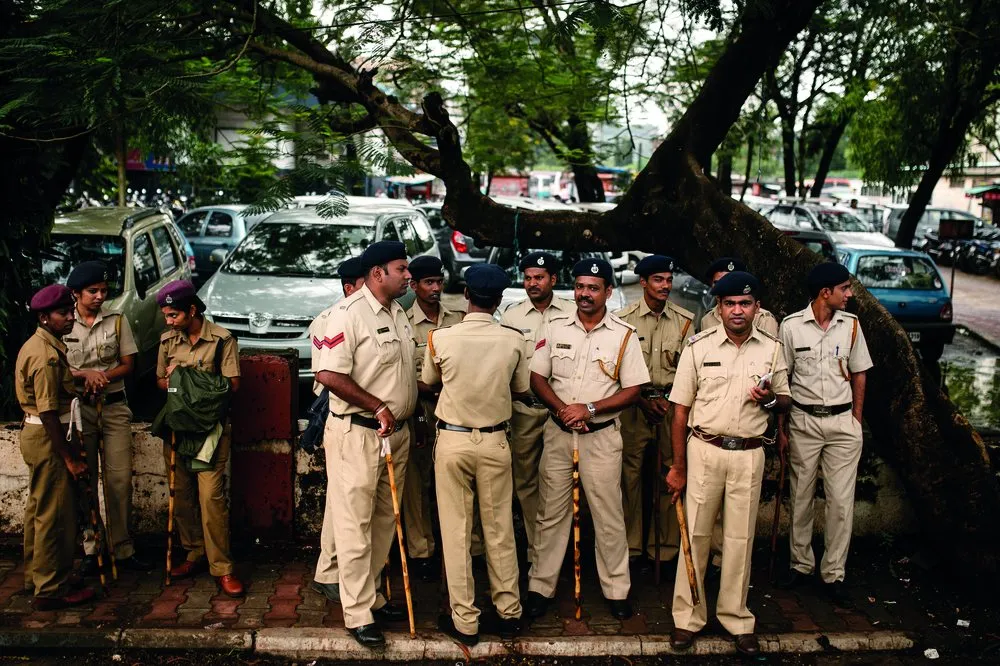
Political implications of maintaining hushed up tones on meat consumption or the audacity to go against it may be one of the reasons why, despite a total makeover, there are still social similarities between the past and the present. At no time did the entire population follow similar eating standards, but there was wide acceptance of the personal choice. The fact that Yajnavalkya’s quotes (and of several others, quoting whom wouldn’t be the wisest thing at this place and time) still exist exemplifies the standards of tolerance and respect towards opposing views. However, the modern Indian political man decided to nitro-boost the potential in meat. We saw slaughtered cow heads inside temples and pig carcasses in mosques, as two nation theories were being drafted.
Cheaply printed, easily available posters and calendars showed a cow in each religious illustration. So, an attack on bovinity was no more an act of mischief, but turned into a planned assault on thousands of years of history. A smart nexus between the opposing political poles created unthinking white-walkers out of the participating enthusiasts, who unfortunately became our immediate forefathers. And from the tall, broad shouldered, aquiline nosed, fair ancestors, we created an unrelenting race of intolerant touchy individuals with long noses (Pinocchio?) and short statures.
What breeds narrow minds and what legacies they leave is evident from the hypocrisy so damningly remnant in our days. Rallies, protests, chest beating, sabre flashing, slogan shouting and flag wagging play in an unending loop against slaughtering the ‘mother’ in the animal kingdom, as unclaimed cows roam about the streets of every single Indian town and city amid traffic, eating filth, getting their hooves trampled upon by desperados on bikes and cars. Venom is spewed in abundance in newsrooms, drawing rooms and tea stalls, upon those who have tasted the forbidden meat, while the emancipator government allows India’s status – of the largest exporter of beef – to stay put.
Do we really want to limit our ancestry to a few decades? Taking cues on our dietary plans from those ignorant about the history and heritage of our national tolerance? Being a non-practising yet proud Hindu, I can’t but zoom out of this microscoped version of my identity. And every time a man is lynched for eating something aghnya, my eyes drift to the thick bundle of newspaper strips where young boys have been molested in churches, young girls have been raped in their neighbourhoods, the homeless have been killed on sidewalks, and thousands murdered in the name of honour. This is not about taking sides, or passing judgements over right and wrong; nor about hurting someone or getting hurt, instead. It’s just about an essential condiment of sanity – common sense.
From the August 2016 issue of FHM India.
Spotted a mistake, or your photo used without permission? Report a correction













 in your inbox