
Brewing music online: Maati Baani
Nirali and Kartik have revolutionised the music scene in India with creative collaborations on the Internet. Their band, Maati Baani, was an impressive entrée at the World Sacred Spirit Festival in Jodhpur.



Two people come together and form a band. This is how most duo stories go. How is Maati Baani different?
Kartik: Before we formed Maati Baani, we both had our individual careers and we were doing well. Nirali was into Hindustani classical and I was composing for TV ads. We still do. We were happy but felt a void, like there was something missing in our music.

Nirali: It was out of that creative chaos that we formed Maati Baani, which would be our outlet for the music we would have liked to do. We could do whatever we wanted to and upload it on Youtube! It was a simple and exciting thought. We made a conscious decision of making original music and to collaborate with different artistes. So, our focus is more collaborative, rather than a duo taking the lead for everything.
You collaborate with a lot of artistes, both from India and abroad and what really impressed us was how it’s all done through the Internet. How does Maati Baani really function?
Before we do a song, we don’t really decide the course it will take. Once, while we were in France, we were inspired to do a swing track after listening to someone playing an upbeat swing pattern. We didn’t finish doing the song while we were there. And when we came back to India, we felt this song should have musicians who’ve learnt the style and play. I started looking up on the net and hit upon a saxophonist and shot him a mail requesting some collaboration. He replied positively.
Similarly, we also contacted other musicians featured in the song! Though it is a time consuming process, the way it sounds after all the inputs, it makes it worth the effort. We got a hang of creating music with musicians from different countries and this gradually became our style. And now, we are about to release a full-fledged series featuring a lot of musicians across the world through Internet collaborations.
Who writes the music for your songs? How about the lyrics?
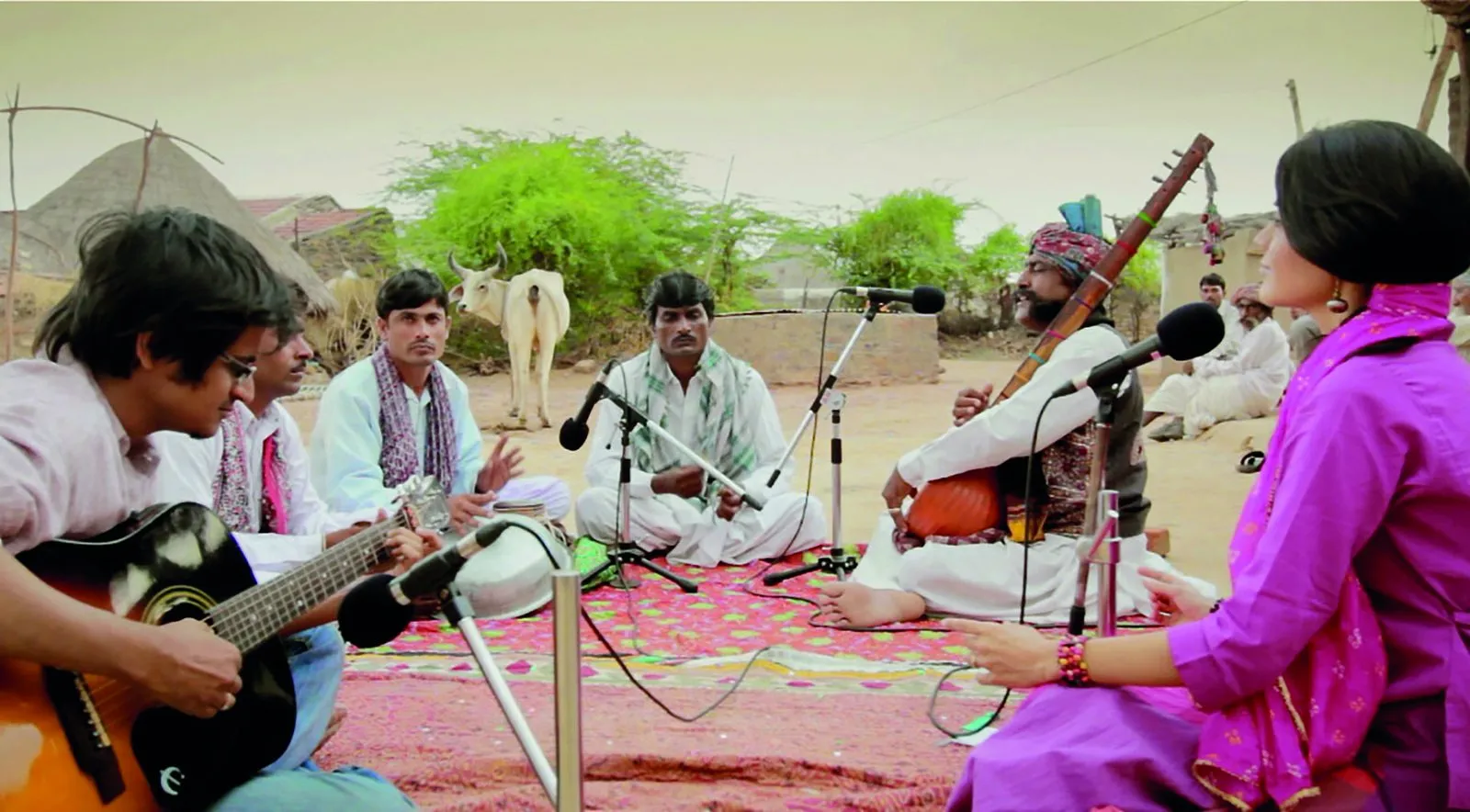
Nirali: While creating a composition, both of us contribute equally and the music production is done completely by Kartik. The way he brings different styles of music seamlessly in one song is incredible! It doesn’t sound patchy or force fitted. But to make it sound like a seamless song, it takes a good amount of time! Like a real pashmina shawl.
Kartik: For us the lyrics are important, and we work with writers who are poetic yet simple. In Rang Rangiya (our Indo-Pak collaboration for Independence Day) we used Urdu, Punjabi and Hindi to pen the song and it was beautifully done by Subratsinha and Manoj Yadav.
Sometimes if the time is right and we are in the mood for it, we write the songs ourselves.
Very impressive production, Kartik. I was just listening to Baawariya and the clarinet being played like a flute was just amazing. Do you brief the artistes on what flavour their instruments should bring to the songs?

Thanks! Yes, I do. Once I start on a song I know which path to go on to. Sometimes, I write parts for the musicians and sometimes I edit the improvised structures that they’ve played.
However, I follow the adage, ‘a song’s soul lies in its melody’. And I prefer to keep sing-able solos for instruments that are in the song.

How independently, really, do the collaborators function?
Kartik: We just give them a path and they are free to improvise on them. In Balma, most of the musicians were sent the chord structure and then they played lots of versions of their solos and parts, and we edited them and made one seamless piece out of it. Recently for our new series, we had a clarinet duo from Amsterdam playing for us, and I had to teach them Raga Sarang as the song is based on it. They learnt it by heart and then improvised on the song with this new knowledge of the raga. It was beautiful!
There must be a lot of back and forth between you guys and the artistes. How long does a song typically take to be ready to be uploaded?
Nirali: Definitely, there’s a lot of back and forth that goes in! But once we have a song in mind and the quality that we aim for, we don’t mind giving it the time it demands. If everything is set right, a song takes about a month, but sometimes due to a lot of artistes and availability issues it might take several months.
Apart from your music, your videos stand out. I personally love the locations you shoot in. Are you also involved in the shots of other artistes, like in Balma, or do they shoot themselves and email them to you?
Kartik: Yes! We send them a brief of where they could shoot and some picture references. We also find a videographer in the city where the artiste is. We send him a detailed note on how we want the shoot to be. Also while on shoot, they send us snaps of the place, so we know what’s happening. Most of the times it goes right! The whole idea is to get the local flavour of the place where the artiste belongs to.

Some of your videos remind me of the Pakistani concept of Coke Studio, where artistes are away in separate studios or locations and record their music from there. Did you draw some inspiration from this?
The big difference between our collaborations and other shows is that we collaborate remotely using the Internet. Our rehearsals are online and we meet online.
We started working on Balma three years ago and took nine months to produce it and at that time we were inspired by Playing for Change, which featured musicians jamming outdoors.
Do new, unheard of artistes ever contact you to collaborate?
Yes they do. We’ve had requests from unheard groups in Romania to musicians from Rajasthan.
How do you pick your artistes?

It’s the most fun and interesting process of our songs. We just go on a rampage on Youtube to find fresh sounds. Once we find something, we make space for it in the song. Some artistes are aware of our requirements… an audio and a video setup. But most of the folk musicians need a video and an audio team arranged as we prefer to film and record at the artiste’s location. These teams travel to their homes for the job. Sometimes it takes us months to convince them, but for us to record artistes who play rare and almost extinct instruments is a priority.
I think it’s pretty brave to have international artistes sing in their language. They definitely bring great vibrations and freshness to the songs. But did you not feel it safer to limit them to instruments?
Maati Baani was created to collaborate and to explore the fine areas of music, which exist in different parts of the world. When we say music is a universal language, we can’t limit ourselves to one area or language. We wanted to break that safety net by creating music that has no rules.
No matter what the tempo of your songs are, the sound brings an age-old, retro feel of leisurely and unhurried relaxation. You guys are pretty young. Isn’t this an anomaly?
Thanks for the compliment! It’s because we create these songs in an unhurried way. We sometimes take a lot of time, waiting for the perfect melody or groove to occur. Also we try to use organic sounds as much as possible. There’s a lot of Indian classical and blues music going on in our house. We think the pace the world is moving at, has to slow down. If music can make that happen, we would be more than happy.
With more and more folk sounds being fused with western styles and instruments, isn’t there a threat to their traditional signature? I know this is also documenting ethnic music, but with a slightly new angle.
We look at it in a different perspective. In fact the more and more it’s used the better, because if a person likes the instrument or vocal, he will definitely try to find the source. At least, it’s not completely forgotten. On one hand there is a lot of curiosity amongst the younger generation about folk cultures and artistes and on the other hand there is a wealth of artistes who are unheard.

Tell us something about your new web series. I’ve heard there are millions of people from as many countries collaborating with you this time. Damn!
Hahaha! I wish this was true. Anyone in the Milky Way is welcome to collaborate with us (laughs). The upcoming series is a new epitome of collaboration, wherein we have 50 artistes from 20 countries. We discovered these artistes and made the songs online, with almost no travel. It’s like a handshake with different cultures that celebrates the oneness in music and humanity in general. Through the series we want to establish that technology and culture can go hand in hand.
So, how do you translate your style to live performances? Being in different cities how do you practice for them?
Before the performances we call all the artistes to Mumbai where we are based. We rehearse a lot before any performance. They stay with us rather than putting up in a hotel. Also wherever we are performing, we try to find some local artistes to have that flavour in our songs.
Tell us something about the changing music scene in India.
Youtube has opened up a new treasure and it’s exploding with new music every day. Also the listeners are looking more towards an ‘experience’ rather than a one time show. It’s an exciting time!
Who are your personal favourites that you listen to very often these days?
Nirali: Anoushka Shankar, Tunde Jegede, all Indian classical legends.
Kartik: Shankar Tucker’s album Filament is our common favourite.
Who did you perform with in the World Sacred Spirit Festival? This was your first time there.
We were really excited to play in a Sufi setup! So for this performance, we had a new setup and a new sound. We had an Iranian oud player and a French saxophonist with folk artistes from Kutchh performing with us. We played some new numbers keeping in mind the beautiful location of the Mehrangarh Fort. It was pretty amazing!
From the March 2016 issue of FHM India.
Spotted a mistake, or your photo used without permission? Report a correction










 in your inbox