
Conscious Connoisseur
India’s First Winemaker, Abhay Kewadkar, travels all over the world to find well-balanced wines that are versatile and brings them back to create expressions of the spirit fit for the global palate.
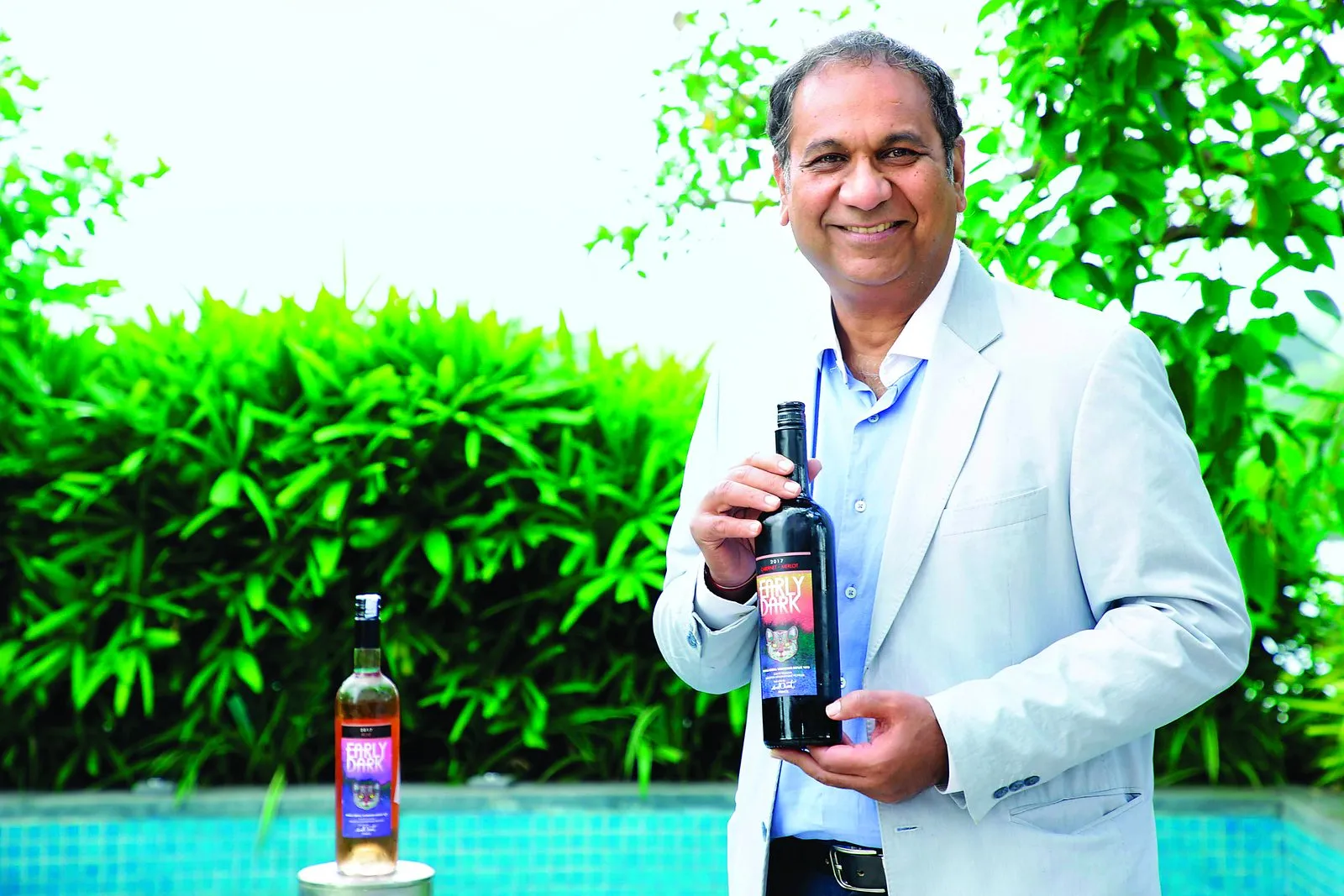



A Chemical Engineer by education, Abhay’s career started in 1984 with Champagne India Ltd., a 100 per cent export-oriented unit in making sparkling wines in India in collaboration with Champagne Piper Heidesiek, France. He has come a full circle, and today is the Managing Director of his own import company Tetrad Global Beverages Pvt Ltd., with pan India distribution. Edited excerpts...
You started in the wine industry right out of engineering college, which is certainly not a conducive environment for cultivating a palate for refined beverages. How big of a cultural shock was the first year, as you were learning about the industry; and what lessons did you take away from that experience?

I had the requisite background knowledge in terms of the fermentation process etc. I probably had tasted good quality wine only once, before I decided to pursue winemaking as a career. This too was champagne and my first impression was that of the drink being too acidic.
Wines available those days were mostly Golkonda and Bosca, which were too sweet and not palatable for me. So, the first 3 months were very critical for me to understand whether I can enjoy wines and whether I am able to differentiate them. Fortunately, I could and within 3 months of joining, I was sent to France for my first training for a period of 6 months.
My first learning was that one should always be ready for challenges, keep an open mind and give in their 100 per cent once they take a decision.
What is your take on the evolving skirmish between ‘old world versus new world’ winemaking, especially considering the almost non-existent Indian identity in the mix? Does India even rank as a serious market in the global industry?
Old world ideally sold their wines on the basis of the concept of “terroir”, which is to do with the region or appellation from where the wine comes from. Bordeaux is an appellation but the names of the grapes in the wine are not mentioned. While the new world such as Australia or South Africa sold the wines based on varietals and names of regions that is reflected in quality wines. The consumer found this aspect more appealing as the information is given upfront on the label while one needs to be very knowledgeable to understand an old world wine label.

In India we do mention the varietals on the label but we do not have an appellation or GI system which can bring in some credibility. Globally there is some awareness now about India being a winemaking country but we are still far from being accepted as a quality winemaking country. Just one or two quality wine producers are not enough.
It won’t be a stretch to say that you have an affinity towards French wine. What is it about that particular region that attracts you? Is there a distinct advantage to being one of the original ‘old world’ wine nations?
I learned about winemaking in France and over the years worked with some of the best winemakers and consultants in while I was there, so it is safe to say that I do have an affinity towards French wines.
The French culture majorly revolves around food and wine, as every region has its own identity when it comes to their association.
Even the audience that drinks wine often, doesn’t always have a clear understanding of when they are paying for a quality product or just the label. What is your view on brands using this ignorance to overcharge customers? How do you decide if a product is worth the price?
It is a known fact that 95 per cent of the consumers drink the label and not the wine. Over the years, wine has developed a tag of being an ‘Aspirational Beverage’ with snobbery associated with it. Then there is always an element of demand and supply. This is true for every product in the luxury segment and wine is no exception. Brands who use this ignorance to their advantage turn out to be more successful. From the consumer’s point of view, he has no other way but to learn by experience or be guided by reviews and tasting notes of others.
Do you think a made in India wine could dominate the global market someday? How do your plans for a microbrewery fit into the picture?
In time to come, ‘Made in India Wines’ will definitely create more awareness and respect in global market, I do not believe it will ever dominate. As I stated earlier, we do not have many exceptional quality vineyards. The cost of production is very high owing to real estate and high-interest rates.
Government laws are not very helpful and are often negated by discriminatory policies.
Despite the large population, the educated wine-drinking crowd in India is a very small niche compared to people who just want to have a good time. Do you see that as a limitation when it comes to scaling a wine business, or is it an advantage to already have a targeted audience base? What challenges do you face when educating people about wine?
The biggest hindrance is the mindset that wines are for the more matured, it cannot be enjoyed like other beverages and requires an understanding of the drink for one to actually have a good time drinking it. It is sad that wine for some reason has taken on that ethos. Whereas even the most expensive of scotch or whiskey does suffer from the stiff uppity image issue.
Another challenge is high market entry costs, bad storage conditions in the trade and alcohol being a grey zone in terms of advertising. Online sales are not allowed, every niche segment needs a digital presence. Wine works out to be an expensive proposition for this aspect, this is indeed a limitation for scaling up a wine business.
From the January 2020 issue of FHM India.
Spotted a mistake, or your photo used without permission? Report a correction












 in your inbox