
Poets of resurrection: the new art of taxidermy
Going beyond the laser-like precision of a surgeon, these artists have buoyed up the art of taxidermy to deific norms.



Ancient scientists and modern philosophers, alike, have spent years trying to capture the essence of the concept of immortality. What happens to the soul post death is a subject of invalidation but the ultimate eventuality of the body is of common knowledge. However, artists have been resurrecting carcasses and infusing new life into them by methods of embalming (religion) and taxidermy (aesthetics) and keeping them ‘alive’ for, what seems like, eternity. Almost with a power of immortality, such artists have risen to prominence in the realms of art and fashion.
What gained popularity as a mix of violence, interior design and decor in the Victorian age, has finally entered the domain of fine art. John Hancock, the daddy of modern taxidermy, introduced dramatic elements into his compositions. His The Struggle with the Quarry may have posed as an understructure for many future artists to build on a greater and way more aesthetic exhibition ground on. Anthropomorphic taxidermy carried this a notch up and in the late 19th century Herman Ploucquet displayed mounted animals as if engaged in human activities. Such transcendence of human intelligence into the beast world seems to have anticipated a whole subgenre of animation films.

In the modern stretch, Damien Hirst took the art scene with a storm with his elaborate, thought provoking themes and shocking exhibitions. Billy Blue (1991) — the shark preserved in formaldehyde, The promise of money (2003), God knows why (2005) and many others have been recorded as masterpieces already. Several new age artists have put the method under their own subjective scanners and come up with bizarre, gory, peaceful and pragmatic artistic interpretations.
We riffled through a range of modern artists from all across the world and got in touch with some of the most talented ones to understand their art and translate the abstract into something more tangible in their own voice.
Kate Clark
What’s your background?

I am from New York and Connecticut, and I’ve lived in Chicago, Detroit, Nantucket, and Rome (Italy). I am now back in Brooklyn, NY, raising two young daughters. I’ve been working full time as an artist for 10 years.
Describe your art.
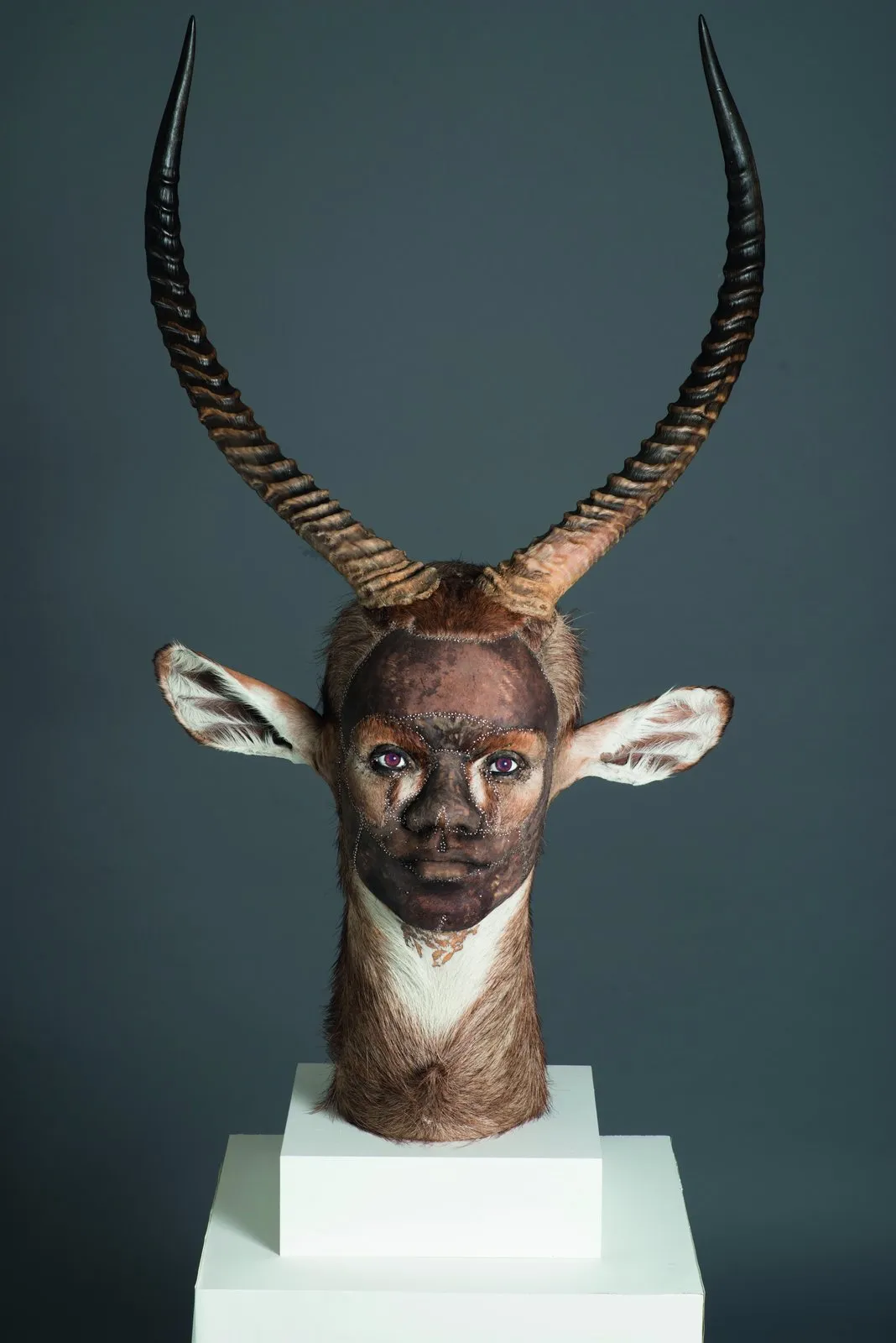
When I make my sculptures I traditionally mount an animal hide on an animal form (like a taxidermist would), but then place the animal’s facial skin onto a face that I have sculpted out of clay to have human features. I sometimes find it hard to believe myself that I use animal hide, but using the animal’s actual skin and transforming it, rather than putting two artificial things together, is the most important concept behind the work. The leather I use as skin for the human face is the skin that covered the animal’s face. I attempt to match up sections of skin, for example, using the animal’s eyelids and lashes around the human-looking eyes. I shave the fur so that the viewer might relate to the oily, porous features that we recognise in our skin. The transformation from animal to human is a smooth one, having the animal’s face reflect ours, not only in form and expression, but also, undeniably, in its similar skin qualities. Although we have an enlightened existence, we are of wild origin, coexisting with the animal kingdom.
How did you develop a taste in taxidermy, despite having a background in painting?
During graduate school my art work became less formal and more conceptual and I started to use taxidermy... not because I loved it or knew anything about it, but instead because it fit my concept: exploring how our facial features evolved to be very communicative, unlike animal features. The work was experimental but when I made my first piece that really resembled the human face, I realised that the ideas it brought up were not only scientific and intellectual but also primal and emotional.

How would you explain what you do with animal carcasses?
Fortunately, I don’t have to work with the animal carcass. I can purchase a clean skin/hide to work with. In fact, the hides I choose are slightly damaged or slightly dry, unwanted by taxidermists who do not want to repair them, especially if the face is the damaged area. I choose to use these hides instead of fresh ones as part of the concept of my work. It’s worthwhile for me to make the repairs and I let them show along with the other transformations I’ve made. Even with slightly damaged areas, the hides are remarkably beautiful in their colouring, details, etc... unlike anything I could make by hand.
In making the work I challenge idealised beauty, or the ideal in general. My work could be considered an aberration – combining two things that aren’t usually combined. My effort to transform them into something believable, or at least suspend disbelief, usually results in the viewer initially resisting the work, but then coming around to find the work irresistible – finding personal meaning in it.
What animals do you mostly work on?
I only work on mammals and I try to work with larger animals so that the face is human scale or larger.
What is the most offbeat animal that you’ve worked on?
Fortunately I don’t need to use exotic animals because I am changing the animal and making it exotic with my work. I use standard antelope, bear, etc. and try to make the sculpture pull the viewer in with a balance between familiar and unfamiliar. Many viewers have suggested that I take them in a monster-like direction, but I think that would make them easier to dismiss. Instead, I make sure the animal stands or sits in a powerful position, while their faces appear comfortable and casual in their transformation. This adds complexity within the viewer/sculpture relationship — the character in the sculpture is comfortable while the viewer is uncomfortable — until he or she spends the time to find beauty or meaning in the work.
What has been your most challenging project?
I was commissioned by a museum to make an 8 foot Greater Kudu antelope and the face took me five or six tries, finishing it almost to completion and then starting over. I had never worked on that enormous scale.
Where all have you displayed your art so far?
My work had been displayed all over the United States and in Europe... in museums, and corporate and private collections.
What has been your inspiration?
I am inspired by artists transforming materials in an interesting way — but the inspiration for the concepts in my work had been a combination of the travel, schooling, relationships, and experiences in my life.
What does your studio look like?

My studio is large, messy, active and full of animal sculptures.
Iris Schieferstein
What’s your background?

I am a sculptor and mother of two children. I studied art in Kassel and Berlin. And I have been working with dead animals (road kill) since 1990.
Describe your art.
Usually I work with dead animals and other materials. But I also make photos, wet preparation objects, as well as sculptural objects and sculptures.
How did you develop a taste in taxidermy?
During the 80s I was making a lot of photos from dead animals. And I was quite interested in the stuff of Honore Fragonard, the French anatom (the branch of science concerned with the bodily structure of humans, animals, and other living organisms, especially as revealed by dissection and the separation of parts). I was also inspired by different artists, cemeteries, religion... All that together brought me close to this art form.
How would you explain what you do with animal carcasses?
The same like a usual taxidermist is doing. But in my case it depends on what kind of art work I produce, wet or dry preparation.
What animals do you mostly work on?
I work on the ones that we eat, shoot or breed, like pigs, horses, cows, chicken, rats, cats, deer, fox, etc. The other ones I use are dead animals protected by the government.
What is the most offbeat animal that you’ve worked on?
None, actually. I don’t kill the animals that I use in my art. I pick those that are killed on road or that are almost dead because of old age or sickness. I don’t need any special animals.
What has been your most challenging project?
Every project is challenging for me. But these days I’m sitting on one called, The Wave, therefore I need thousands of oysters. I’ve been collecting them from restaurants since November last year and still don’t have enough. This wave has to be three to five metres big. So I spend a lot of time cleaning the oysters. That’s a new kind of challenge for me.
You are a designer and quite a popular one too. Tell us something more about it.
I’m not really a designer. I am a sculptor. I never studied design, but at times the fine line between the two starts to fade away. Some of the objects that I created have somehow turned into fashion objects, but I made them all for my photo work.
Where all have you displayed your art so far?
Mostly in Europe. But I’ve also exhibited my artwork in the US, Hong Kong, and Japan, etc.
What has been your inspiration?

There have been several themes that have motivated me to work towards them. Social, political, the role of the women, globalisation, philosophy… Everything around leaves an impression on me. It’s hard to ignore them.
What does your studio look like?
It’s hard for me to answer that. To me it looks like a simple studio, but for some people it looks like a strange workplace... a little chaotic, with materials as different as bones, heads, fabric, machinery and tables lying all around.
Harriet Horton
What’s your background?
I’m a British artist living and working in London, UK. At 21 I left University with a degree in philosophy and started to increase my existing fascination with taxidermy. I’m largely self-taught,
apart from a few days studying with Scottish taxidermist, George Jamieson.
Describe your art.
Taxidermy with a contemporary, pop twist.
How did you develop a taste in taxidermy? Did your background in philosophy have something to do with your decision?

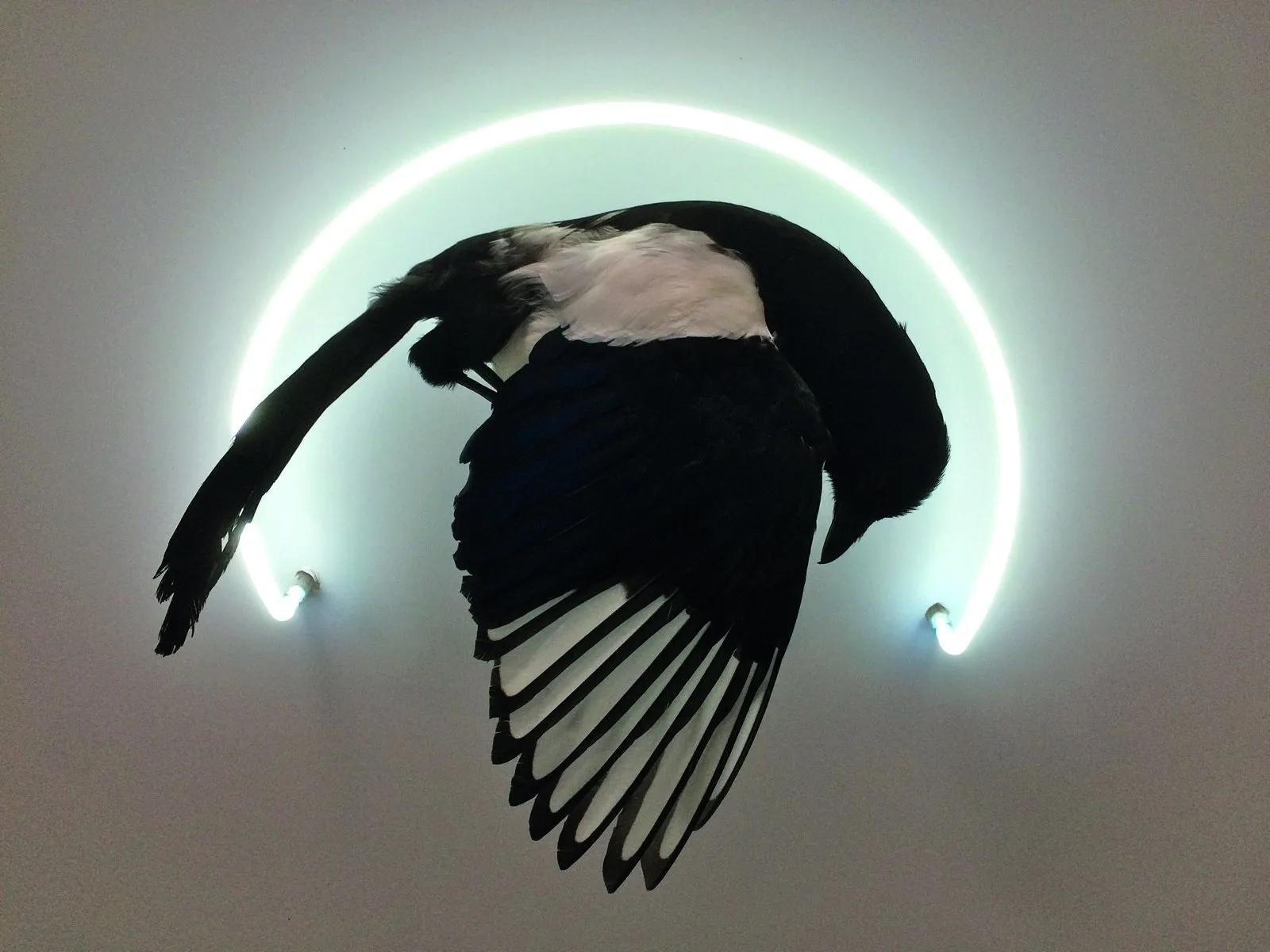
Absolutely! I was, and still am, particularly interested in the origins of ancient Greek aesthetics. My degree was certainly an early development into my work and concept today. When I, initially, set out to study taxidermy, I was really tired of the traditional representation it had. I began experimenting with a few different ideas, always trying to find something both beautiful and respectful. It was combining taxidermy with neon lighting that worked best. I loved how the temperature of the lighting affected the appearance and mood of the animal. It was the aesthetic that I was looking for and now that’s become my signature style.
What animals do you mostly work on?
As an ethical taxidermist I use animals most widely available to me, which – at present – tend to be UK wildlife. I particularly enjoy doing birds, especially the more popular species that people tend not to ignore.
What is the most offbeat animal that you’ve worked on?
Nothing too offbeat, but I once had to do a pig which I didn’t particularly enjoy and won’t be repeating.
What has been your most challenging project?
The most challenging one has to be, definitely, my new body of work for my upcoming solo exhibition in Paris that opens on 27th October. I’m exploring a new relationship between taxidermy and neon to create something different from my previous work. I’ve always said that when animals are deceased their natural colouring and camouflage become redundant. I’ll be experimenting with this idea further by stripping animals of their original colouring and reconstructing it with light.
Preserving animals as if they’re asleep is an amazingly romantic idea. Tell us more…
I often find that when animals are given false eyes they can look terrifying, no matter how good the work is. Taxidermy will never look alive, it’s impossible. I wanted my work to have a softer approach and this really works even when I’m not positioning them ‘asleep’, their eyes are always closed.

Where all have you displayed your art so far?
London and Paris.
What has been your inspiration?
My inspiration has always been the urge to remove the macabre, unethical association from taxidermy.
What does your studio look like?
Always tidy and clean! It’s in an old wool house in East London, so it has a generous ceiling height with all white walls, plenty of plants and my work.
Kimberly Witham

What’s your background?
I grew up in a somewhat rural area. As a child, I had lots of pets and animals (dogs, cats, chickens and my mother kept honey bees). I spent lot of time in the woods and playing outside. Originally, I went to college to study art history. After completing my undergrad degree, I decided to make art rather than write about it. As an art historian I’d been very interested in photography, so I naturally moved in that direction. My love of animals, a background in art history and artistic pursuits all come together in my studio practice.
Describe your art.
All of the artwork I create is focused on the relationship between humans and the natural world. People often love nature for its beauty but do not enjoy the inconveniences it sometimes creates. I strive to create images and objects which are seductively beautiful while at the same time disturbing or unsettling. Aesthetically, my work is also informed by my interest in painting and my studies in art history.
How did you develop a taste in taxidermy?
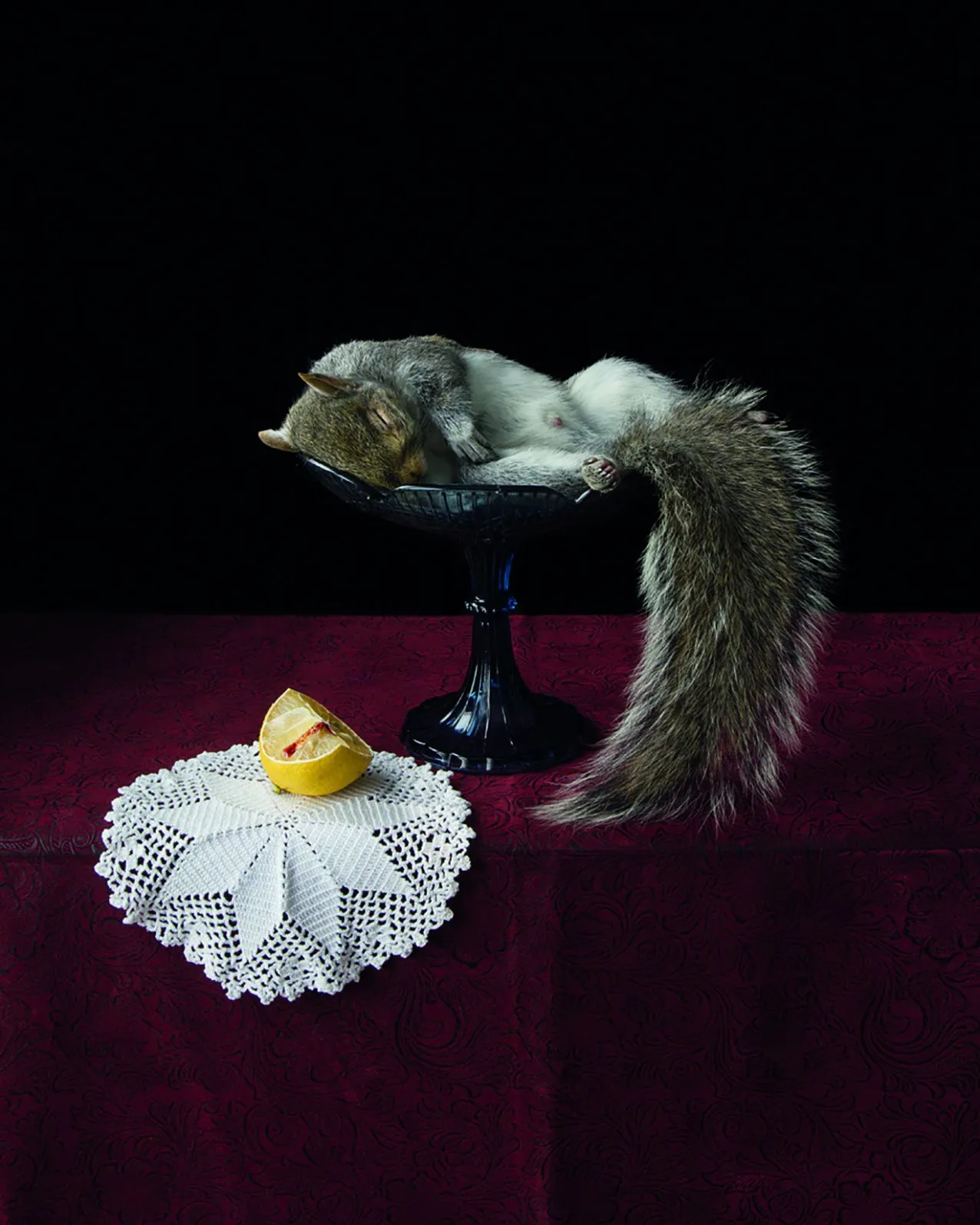
My interest developed as an extension of my photography practice. I’d been making still life photographs which combined domestic items with road kill animals. Since the animals were dead but not preserved through taxidermy, I had to work quickly. I would make small vignettes with animals, dishes, fabric and other household items and then photograph those vignettes. The photographs were a record of a brief sculptural installation that existed only for my viewing. I realised that I could create permanent 3D manifestations of my still life vignettes by preserving the animals.
How would you explain what you do with animal carcasses?
When animals are preserved through taxidermy, only the skin is used. The actual body of the animal is removed from the skin. I bury the carcasses in the woods once the animals have been skinned. I try to preserve the animals in natural poses while placing them in unnatural situations.
What animals do you mostly work on?
Since all of the animals I use are ‘road kill’ I tend to use animals which are common and often hit by cars. Squirrels are by far the most common.
What is the most offbeat animal that you've worked on so far?
I have preserved two small moles. They are incredibly fragile and REALLY small.
What has been your most challenging project?
Well, the moles...
Juxtaposing animals in still life photography is both intriguing and ironic. Tell us more...
There is actually a long history of dead animals in still life imagery. Artists like Jan Weenix and Melchoir DeHondecoeter are two who come to mind to illustrate this point. These artists depicted animals after the hunt, as well as, exotic animals collected by wealthy patrons. The images are meant to depict mankind’s dominion over the natural world. In my images, the animals are all by products of mundane roadside accidents. They are evidence of the modern condition and our broken relationship with the natural world. In the series, Domestic Arrangements I play with the notion of the ‘perfect’ suburban house contrasted with the aftermath of our suburban commuter life style (this might be a particularly American problem).
Where all have you displayed your art so far?
My work has been displayed across the USA and as far away as Australia and the UK. They’ve also been published in several magazines and used as cover illustrations for a number of books. I am represented by a gallery in Boston, Massachusetts. (Gallery Kayafas)
What does your studio look like?
My studio is rather small. It is an enclosed sun room on the front of my house. It is filled with taxidermied animals, bird nests, preserved insects, dishes, fabrics and other domestic items. It has big windows and beautiful light.
From the June 2016 issue of FHM India.
Spotted a mistake, or your photo used without permission? Report a correction







 in your inbox