
To the Mint Road: D Subbarao’s Who Moved My Interest Rate?
As the suspense around the appointment of the new RBI chief turns thicker, D Subbarao – one of the most celebrated RBI governors – tells his story.
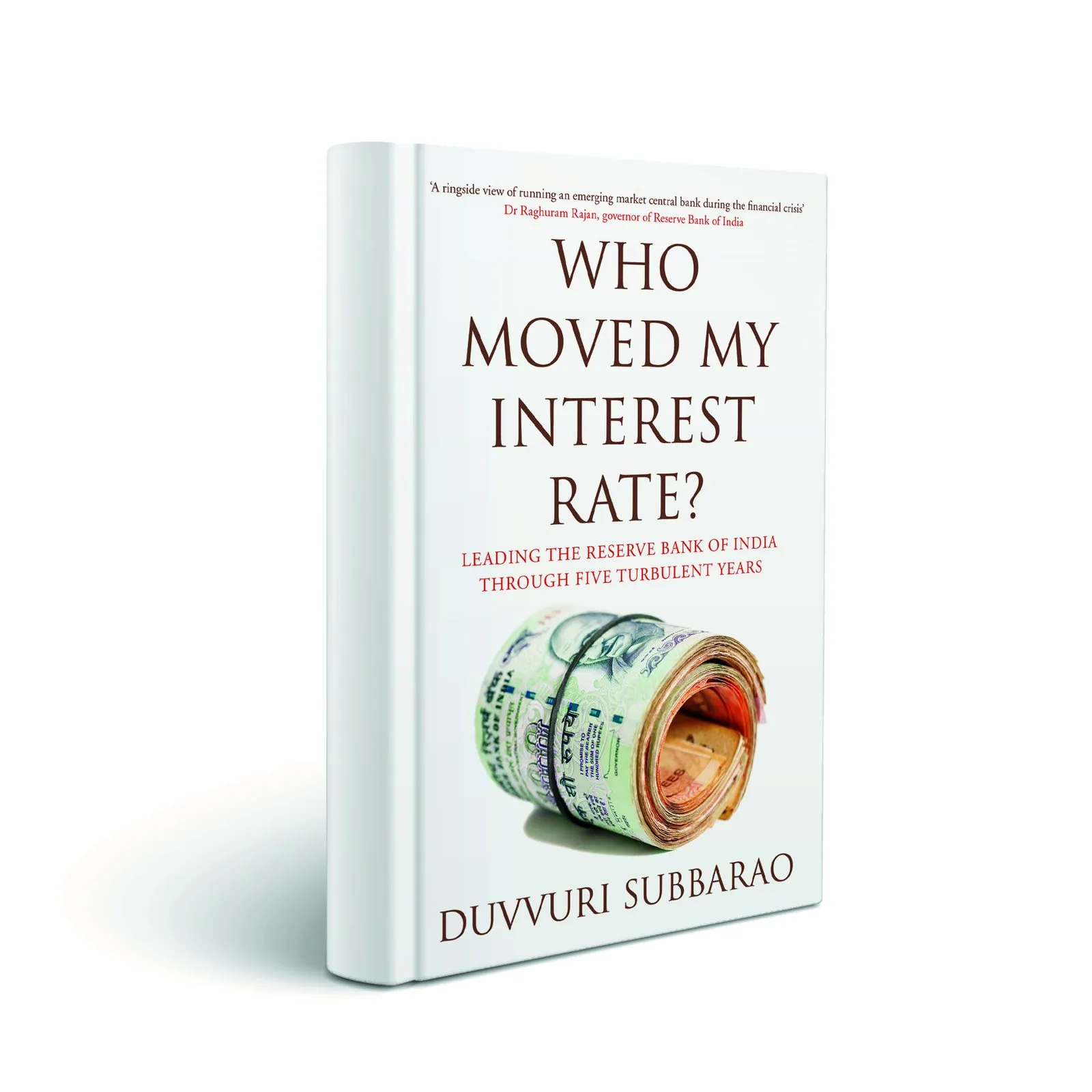



Duvvuri Subbarao’s term as the governor of the Reserve Bank of India from 2008 to 2013 was by all accounts an unusually turbulent period for the world and for India. The global financial crisis erupted within a week of his assuming office. Then, just as the impact of the crisis on India ebbed, the action shifted to combating a decade-high, stubborn inflation during 2009-11, which segued into a battle against a sharp depreciation of the rupee starting mid-2012. Who Moved My Interest Rate is an insider’s account of the dilemmas and quandaries Subbarao confronted while leading the Reserve Bank through these extraordinary economic and political challenges.
Subbarao’s five years at the Reserve Bank also marked an intellectually vigorous period for central banking around the world. Not only did the global financial crisis test the policy force of central banks, but it also raised several questions about the breadth of their mandates and the limitations of their autonomy and accountability. While much of the existing debate is set in the advanced economy context, Who Moved My Interest Rate places these issues squarely in an Indian and emerging market perspective. This is also a compelling chronicle of Subbarao’s attempts to demystify the Reserve Bank and explain to the public its impact on their everyday lives. Honest, authoritative and deeply insightful, this book enhances our understanding of what is, arguably, one of India’s most trusted institutions.

Our currency notes carry a promise by the governor. For example, a ₹10 note has a promise on it, saying: ‘I promise to pay the bearer a sum of ten rupees.’ A woman actually having a ten rupee note in her hand can be quite perplexed by this promise. What does it mean for the governor of the Reserve Bank to promise to pay you ten rupees when you actually have ten rupees in your hand? Tautological as it might seem, it is simply an old-fashioned way of saying that the currency note is legal tender and will be accepted as a medium of exchange on the trust of the Reserve Bank.
The critical word here is ‘trust’, which is the core of any system of money. Paper money originated on the basis of trust, trust that the holder of a note could go to a bank and exchange the note for an equivalent value of gold or silver. If that trust — that the bank would redeem its pledge without fail — held, the note would circulate as a medium of exchange without anyone ever going to the bank to exchange the note for precious metal.
Sure, that explanation of the evolution of money based on trust is persuasive enough. But, is there a deeper meaning to the trust underlying the governor’s promise on the currency note beyond the assurance that the note is legal tender? Shouldn’t trust also extend to an assurance that the Reserve Bank will maintain the purchasing power of the currency by keeping inflation under check? Isn’t price stability, in fact, the reason why almost everywhere in the world, the power to print currency is entrusted with unelected technocrats in a central bank rather than with elected politicians in the government?
Wouldn’t central banks forfeit the trust of their people if they failed to maintain the purchasing power of their currency?
These questions surrounding this broader interpretation of trust become all the more meaningful if we note that the issuance of currency by central banks is no longer governed by the theology of the gold standard — the belief that a central bank must issue currency equivalent only to the value of the precious metal in its vaults. The gold standard was abandoned during the Great Depression of the 1930s and what central banks issue today is fiat currency — that is, currency which derives its value not from any gold or precious metal held by the central bank but from a government decree. The Reserve Bank too has been part of this global shift from the gold standard to fiat currency. In fact, the original Reserve Bank Act which, coincidentally, dates back to 1934, the Great Depression era, prescribed a proportional reserve system whereby, of the total value of notes issued by the Reserve Bank, at least 40 per cent was to be backed by gold bullion and sterling reserves. Subsequent amendments to the Reserve Bank Act have relaxed that provision, and today gold provides only a very small part of the asset-backing for the currency issued by the Reserve Bank; the rest of the cover comes from the domestic and foreign securities held by it.
This breaking of the historical link between the issue of currency by a central bank and its gold holding redefines the basis of public trust in a central bank. The restraint on a central bank to issue currency without bounds is no longer its gold holding but the obligation to preserve the value of the currency by keeping inflation in check. All through my Reserve Bank tenure, I firmly believed that it is this broader interpretation of trust that underlies the governor’s promise to pay the bearer ‘the sum of ten rupees’.
By far the most important facet of currency management is building in security features to prevent counterfeiting. There are several considerations that go into the design of a currency note, such as reflection of the culture, history and ethos of the nation, a pleasing and appealing look and feel, sensitivity to the needs of differently abled people, particularly those with vision deficiencies, and amenability to mechanized processing. An overriding consideration, of course, is to make counterfeiting difficult and expensive. Keeping ahead of counterfeiters by constantly enhancing the security features is the only way by which central banks can confront this constant occupational hazard.
The most effective deterrent to counterfeiting is wide public awareness of the security features so that people are able to tell a counterfeit note from a genuine one. This is the motivation for the extensive awareness campaign that the Reserve Bank runs in the media to educate people on the security features of the currency. That shopkeepers routinely hold up high denomination notes to the light with the confidence of people who know how to tell the true from the false is everyday proof of the success of this scheme.
In managing this awareness campaign, the Reserve Bank of India faces two dilemmas. The more straightforward dilemma is that the campaign has to educate people without unduly alarming them. The second, more difficult dilemma is that the awareness drive also gives information to counterfeiters.
From the August 2016 issue of FHM India.
Spotted a mistake, or your photo used without permission? Report a correction












 in your inbox