
Your Stag Do 2023: Are You Man Enough For Space?
Civilian space travel is coming in your lifetime. When can you pack your bags, will space destroy your mind, what to watch, read, wear and eat on the way – and what zero-G actually feels like.


Question 1: When can I pack my bags?
Let’s clear something up right off the bat: you, yes you, will be able to go into space in your lifetime. “We’re on the cusp of what we only read about in books 50 years ago – hotels in space, moving sidewalks, orbital villages. It’s starting to happen.”
These aren’t the words of some fruitloop sci-fi obsessive. It’s Bobby Block – a man who has worked at the top of some of the biggest private-sector space firms in the world.

“It is extremely possible,” says Block, “that in the near future, if Valentine’s Day was approaching, for a modest sum you and your sweetheart could spend a few days in a spaceship, going round the moon.” Block currently works for The Golden Spike Company, one of the many businesses striving to make the dream of affordable, civilian space travel a reality in the next couple of decades. Last year, its hand forced by the global recession, the Obama administration dramatically cut funding to its space agency NASA. The budget could not stretch to the cosmos when there were expensive wars being waged in Afghanistan and Iraq. A host of billionaire entrepreneurs across the world perceived this as the crack of a starter’s pistol. If the US government didn’t have the cojones to take the human race to the stars, then they certainly did. Ever wonder what the heads of companies like Google, PayPal and Virgin are saving up for? It’s this.
“It’s like telecoms,” says Mike Gold, operations director for Bigelow Aerospace, the company that is ploughing millions into developing large habitats (think floating blocks of flats) for space. “In the past, only governments could develop communication satellites and launch them. Once the private sector was able to develop and deploy them, you had the explosion of the telecom industry.”
The thing that’s made space travel so expensive is the cost of blasting off. Currently, the rockets we use to launch us out of the atmosphere can only be used once. Imagine if after each time an airline flew a plane it had to scrap it and build a new one. This is the situation with space travel, but things are set to change. SpaceX, the company founded by dotcom billionaire Elon Musk, is working hard on making the first reusable rockets. And sources tell FHM they’re close to a breakthrough.

“Civilian space travel is seen as a carnival for wealthy people,” says Block. “But research for space exploration is going to change the Earth in revolutionary ways.” Gold agrees: “You’ll soon be able to fly from London to Tokyo in under an hour. I look forward to when the taxi ride to the airport is longer than the flight.”
All the companies agree on one thing: once companies and investors recognise space as a viable commercial market, the cost of leaving Earth for regular people will come down a lot.
“You should be able to go down to one of the many launch pads across the world, and watch a rocket blast into space with humans on board, the same way you can go to an airport and watch a plane take off,” says Block. “That’s where this industry is heading. It’s a huge challenge. But we’re up to it.”
Question 2: Will space destroy my mind?
Space. It’s all fun and games until your eyes explode. We asked Dr Kevin Fong – as seen on BBC2’s Horizon – to tell us about some of extraterrestrial travel’s biggest health risks. “Space looks like the most wonderful, Zen-like experience,” says Dr Fong. “Floating around, everyone’s smiling. Actually, it’s uncomfortable, dangerous, with an ever-present threat of a very violent death.” Here are just a few of the mind and body-destroying maladies awaiting any budding astronauts, none of which sound like much fun when you’re 400 million miles from a GP.
Space madness: “Space is tremendously challenging psychologically. You’re in a confined area, death awaits you about an inch away on the other side of the hull, you’re living inside a machine – these aren’t just houses in space, they’re constructions that have to work to keep you alive. You’re isolated from all your creature comforts and everyone’s monitoring what you’re doing. It’s like Big Brother in space, but the evictions are kind of messier. The thing about taking fee-paying people up there is that there’s a lower grade of psychological selection for space tourists, so you have to accept that there’s a possibly higher incidence of crazy-person-aboard-ship syndrome.”
Deformed eyeballs: “Inside your central nervous system – your brain and spinal cord – there’s liquid circulating called the cerebrospinal fluid. In space, something happens which causes a swelling of the brain. It may be because this fluid isn’t draining properly, no one’s really sure, but as the brain swells, it pushes on the eyes and deforms the eyeballs. There are a couple of big problems there: one is that your vision is changing; the second thing is you’ve got this raised pressure in the central nervous system that could cause damage.”
Crumbling bones: “Space turns athletic people – astronauts – into couch potatoes. Their muscles waste, their bones waste – if you don’t use it, you lose it, and going into space, you’re not using it. They lose bone mass and muscle mass from the bits of the skeleton that are load-bearing areas. In those regions, you lose on average 1-2% bone mineral per month. At that kind of loss, you don’t have to go long before you’re into real trouble.”
Boiling blood: “As pressure drops, so does the boiling point of liquid. If you boil a cup of tea on the summit of Everest, the water boils at 70 degrees, rather than 100 degrees. Now, if you keep dropping the pressure, eventually you get to the point at which water will boil at 37 degrees – the core temperature of your body. If you’re at low enough pressure, as in the vacuum of space, the water in the soft tissues of your body and the blood in your veins begins to boil and form bubbles of vapour. If that goes on long enough, it will kill you.”
Loss of fingernails: “Spacesuits look like big quilts and you think, ‘Gosh, that must be the most comfy thing to wear’ – but they’re really not. It’s like wriggling into a suit of armour lined with a wetsuit, and you’re out there for six hours at a time. The gloves and boots in particular press up against your finger and toenails, putting pressure on them. The nail bed needs a supply of blood, and if that is obstructed, the nails lose their blood supply and the whole thing just comes off.”
Question 3: What’s on the in-flight entertainment?
So you’ve bought a ticket to the moon, hopped onboard the shuttle and now have nine hours to kill before touchdown. It seems only right you use the journey to enjoy some of the finest space films ever made. But what does Dr Hugh Mortimer – planetary researcher and scientific adviser for last year’s mega-hit Prometheus – make of the scientific theories at the heart of these six classics? A word of warning: here be spoilers…
Moon (2009) The plot: Trippy sci-fi in which Sam Rockwell’s moon miner discovers he’s the victim of a human cloning operation. Dr Hugh: “Space mining is big at the moment, and we’re really close to how it’s portrayed in this film. Two companies – one funded by (Google bosses) Eric Schmidt and Larry Page, the other by director James Cameron – are trying to set up mining missions to asteroids.”
Barbarella (1968) The plot: Jane Fonda jiggles her way around various planets in a space-bikini, meeting many interesting characters along the way. Dr H: “I’m pretty convinced that complex life has developed somewhere. Twenty years ago we discovered the first planet outside of our solar system. Since then we’ve found 5,800 more, as well as countless other candidates that we think are planets.”
Star Trek (2009) The plot: Captain James T Kirk and his merry band of Starfleet chums zip all across the galaxy using faster-than-light travel to save humanity from Eric Bana’s dastardly Nero. Dr H: “There’s nothing scientifically wrong with the principle of warp speed. You compress space in front of you and expand it behind you, meaning you’re not violating the laws of relativity but are travelling faster than the speed of light. I’ve heard rumours that there are secret science teams in the US researching this.”
Aliens (1986) The plot: A band of marines go into hyper-sleep in order to travel across the galaxy to wipe out a planet of predatory beasts. Dr H: “Space is so vast that to get to another star system you’d either have to travel incredibly fast or put yourself into cryogenic sleep. One way of doing this is low-temperature stasis – cooling the body down to the point of an induced state of hibernation. It’s been tried on mice and pigs and works most of the time.”
Total Recall (1990) The plot: Arnold Schwarzenegger goes on an ultra-violent vacation to Mars, where humanity’s colonists are busy mining the planet for its valuable resources. Dr H: “Mars colonies have been a research topic for a while but it’s still too expensive. Within the next 20 years we should have a permanently manned lunar base, which could then be used as a stop-off point between Earth and Mars.”
2001: A Space Odyssey (1968) The plot: The crew of a spaceship are fatally betrayed by HAL, their onboard computer. Dr H: “We already rely on computers to land our planes, trade our finances and recognise our faces. Using something called ‘Strong AI’ (artificial intelligence) people are already trying to build computer versions of the human brain. We would be giving computers the ability to think for themselves, in all areas.”
Question 4: What to read on a long-haul space flight?
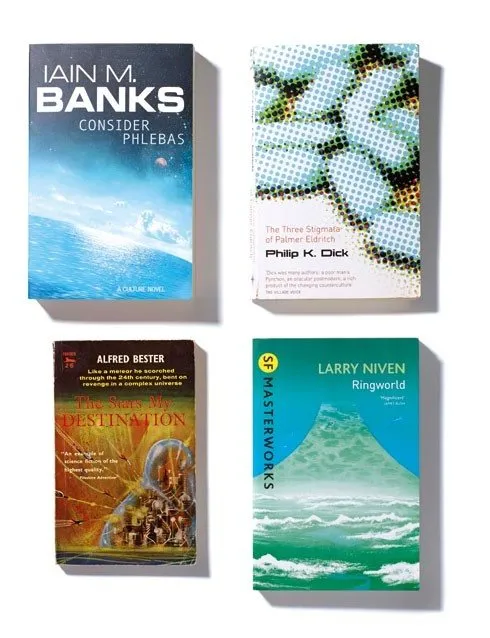
Consider Phlebas (1987) by Iain M Banks: A proper, no-nonsense space opera. Warring civilisations, galactic politics and a truly epic scope make what would become the first book in Banks’s Culture saga a wicked read. Will take ages to finish, too. Star Wars with a degree.
The Three Stigmata Of Palmer Eldritch (1965) by Philip K Dick: Bored colonists on a sand-blasted, inhospitable Mars use psychedelic drugs to help pass the time. Mind-bendingly weird. Inception, but with drugs instead of sleep.
The Stars My Destination (1956) by Alfred Bester: Sci-fi at its maddest and most epic: Gully Foyle is an uneducated thug of a man, shipwrecked in deep space. When a rescue ship passes him by, he becomes hell-bent on seeking revenge – even if it takes a total rebuilding of his mind and body. A Jason Statham film crossed with 2001: A Space Odyssey.
Ringworld (1970) by Larry Niven: A mysterious metallic ring, a million miles wide and rotating around a far-off star, is the destination for two bored humans determined to discover its secrets. Was the Ringworld built as shelter from a galactic explosion, or is it part of a plan by alien puppeteers to breed human beings? Stargate, but stranger.
…And how long do I have to read them? The distance between Earth and Mars is always changing (because of their orbits), but if you timed take-off right it would be about 34 million miles. A rocket-powered flight would take about 6,000 hours.
Question 5: How does one poop in space? …And four other things you didn’t know you didn’t know
How does one poop? The majority of space toilets use fan-driven suction systems, instead of water, to pull waste away from astronauts’ bodies before zero-G can begin playing revolting havoc. On the International Space Station, urine is recycled and turned into drinking water. Poo is dried out, compressed, put in aluminium containers, and disposed of back on Earth.
Has anyone died up there? Nobody has ever died out in space. There are conspiracy theorists that allege that Yuri Gagarin — the first man to leave the Earth’s atmosphere — was simply the first man to survive leaving the Earth’s atmosphere.
What happens if you take the suit off? Surprisingly, you don’t need a spacesuit to go into space. The crew on early Russian flights wore sportswear inside their capsules. Even if you leave the ship, you don’t immediately explode or freeze to death: in space you’re surrounded by a vacuum, so you’ll get cold in the shade and warm in the light.
Who owns the Moon? It’s first come, first served. “If your company reaches the moon and begins mining, you’d have dominion over the land you’ve settled,” says Bigelow Aerospace’s Mike Gold.
Question 6: What am I going to wear in space?
Super hi-tech space clobber that’s also ready to wear down here on planet Earth.
The Omega Speedmaster Professional, worn by Buzz Aldrin over his space suit in 1967, was the first (and only) watch to ever go to the moon. It was chosen by NASA owing to its toughness. Water-resistant up to 167 feet, Hesalite crystal face, rhodium-plated stainless-steel strap. Price: ₹1,96,000
Dreamed up by a bunch of MIT graduates called the Ministry of Supply, the Apollo Shirt is crammed to the cuffs with genuine spacesuit technology: NASA Phase-Change Material, which absorbs heat from your body and then releases it when your core temperature drops, a lab-tested antimicrobial coating so you don’t have to worry about B.O., and fabric woven from thermoset yarns, making it entirely wrinkle-free. Price (import only): ₹5,872
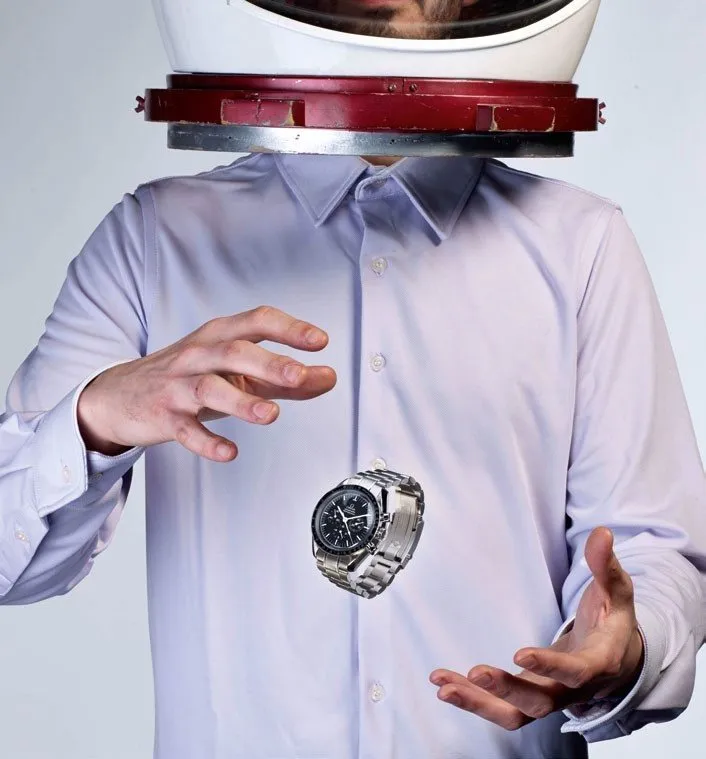
To infinity... No, it’s not some bloke with too much time on his hands at a Toy Story convention. It is, in fact, the prototype of NASA’s next spacesuit – the Z-1. Designed specifically for future missions to the moon and Mars, the Z-1 is more mobile, easier to get into and more stylish than anything that’s come before. The fact that the next generation of astronauts will be floating around the cosmos dressed as Buzz Lightyear is – in our opinion – pretty cool actually.
Question 7: What’s it like to blast off?
“Like going over Niagara Falls in a flaming barrel,” is how one astronaut described taking off in a rocket. We sent FHM space cadet Dan Masoliver to the QinetiQ Human Centrifuge in Farnborough to find out how 4Gs feel (the level astronauts leaving Earth on a low-orbital spacecraft experience).
- Between 2-3Gs, Dan experienced “greyout” – there’s a loss of colour and peripheral vision.
- From 3Gs, the heart has to start beating extraordinarily fast and hard as all the blood in the body is pulled towards the feet.
- At 4Gs, Dan’s eyesight failed entirely.
- At 5Gs, most people experience G-LOC (G-force loss of consciousness – AKA passing out).
- At 9Gs, his weight would go from 80kg to 720kg.
- At 16Gs, vibrations begin rupturing organs.
Question 8: What’s on the menu?
We got hold of a load of space snacks and conducted a blind taste test.

- Vanilla and chocolate sandwich: “Incredibly hard and powdery.”
- Neapolitan ice cream: “Does taste like Neapolitan ice cream. Becomes gungy. You’ll need a space toothpick.”
- Mint and chocolate-chip ice cream: “A winner. Smooth and not too sweet.”
- Strawberries: “These are good! Strawberries with the natural sugar taken out and replaced with normal sugar.”
- Peaches: “Like someone spilt tinned peaches over a cardboard box. And you eat the cardboard box.”
- Apple wedges: “Tastes like warm apple pie. But feels like dry, crusty bread.”
- Vacuum-packed idli, sambhar powder and coconut chutney dust: Dr K Radhakrishna, of the Defence Food Research Laboratory (DFRL) in Mysore, has come up with space snacks, mostly South Indian. Proof that Indians can open a dhaba anywhere.
Question 9: Can I be captain?
The short answer: yes! But you might want to hold fire on purchasing that Starfleet Command tunic for the moment. You’ve got some hard work to do before anyone’s going to let you behind the controls of anything as cool as a spacecraft.
“In the future, captains of orbital spacecrafts will be ex-airline pilots or test pilots who have a degree in astronautics or space engineering,” says veteran European Space Agency astronaut Jean-François Clervoy. “If you have a problem hundreds of thousands of miles from Earth, you need to know how to fix it. Mis-controlling the fuel in an airplane is not that dramatic a problem. In a spaceship, if you mis-timed a rocket-engine boost for injection into orbit, you’d leave the planet on a trajectory that meant you’d never return to Earth. Doomed.”
So what would an FHM reader have to do to be in with a chance of one day having “Space Captain” on their CV? “The most important thing is that they can demonstrate that from an early age they were keen on flying and being in the air. They should enrol at one of the many test-pilot schools across the world and get around 2,000 hours of flight time under their belt, operating high-performance aircrafts.”
The good news is that once you’ve got your pilot’s licence, spent enough time in the air and graduated with a degree in something space-sciency you’ll be on a pretty good salary from the moment you don your captain’s hat. “Basic pay will be around ₹82,49,760 a year,” says Clervoy. “And that will rise to ₹1,64,99,520, depending on how often you fly.”
Question 10: What does zero-G actually feel like?
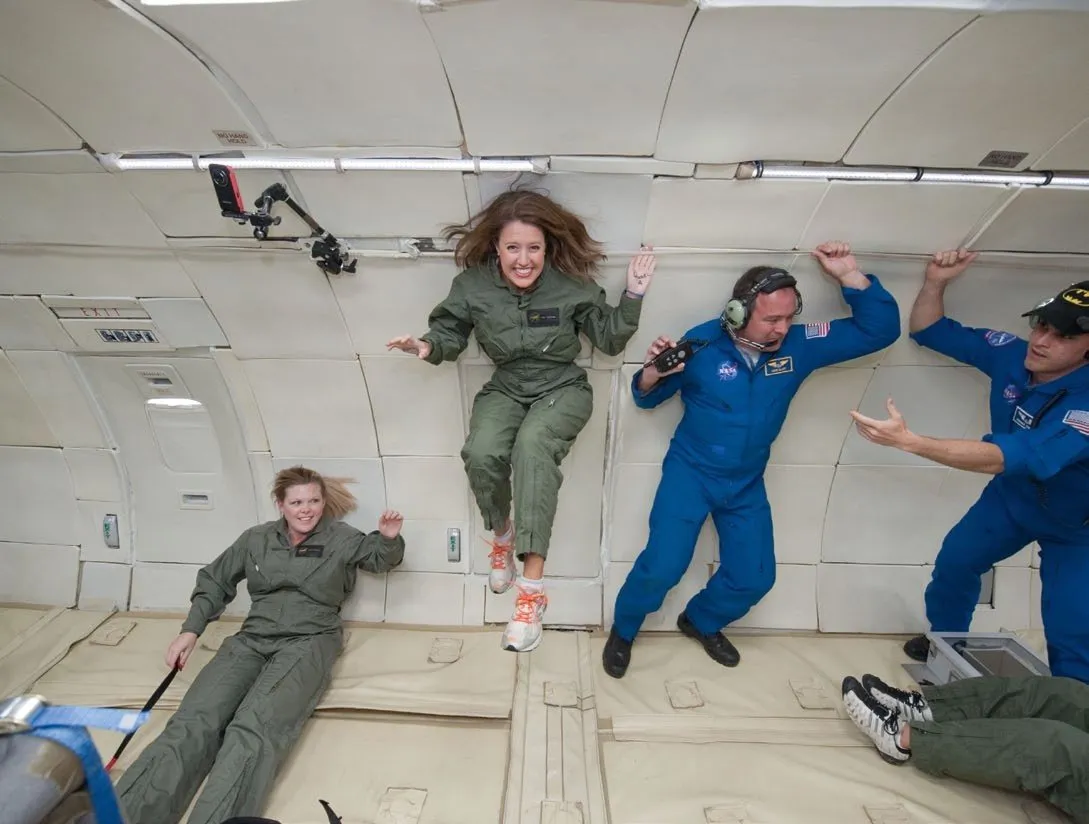
Like every man born since the first space shuttle launched from Cape Canaveral, FHM staffer Dan has often stared into the night sky and dreamed of following in the gravity-defying footsteps of his astronaut heroes. We sent him to Florida to board a parabolic plane and experience first-hand the weightlessness of space.
“As I lie face down on the carpeted floor of a tiny twin-engine plane, several thousand feet over the Gulf of Mexico, the pilot pushes forward on his stick and sends us plummeting towards the open ocean below in a sharp nosedive. Suddenly, this seems more like the worst nightmare of anyone with a phobia of flying than my childhood dream of floating among the stars.
“This is the first stomach-churning stage of the aerobatic manoeuvre known as a parabola – used by NASA and more recently a handful of commercial companies offering zero-gravity experiences – to re-create conditions felt by astronauts as they leave the atmosphere and break free from Earth’s gravitational pull.
“As the pilot pulls back on his controls, we enter phase two of the parabola, a steep 45-degree climb. At 1.8Gs of gravity, my body is almost twice as heavy as on ground level, forcing me to eat carpet, in the worst possible sense. Then it happens. As we level out of our climb, first my hands, then my shoulders, then suddenly my entire body is pulled up, and I start falling. Upwards.
“Jean-François Clervoy, a French astronaut with 675 hours in space under his belt, told FHM that with zero-G ‘you fly even more freely than the birds in the air or the fish swim in the sea’ – and for a combined total of three minutes I know exactly what he means. With no resistance against your weightless limbs, you can somersault, air-swim or just float. Even within the cramped cabin of the small plane, the freedom is like no feeling on Earth.
“Astronauts aboard the International Space Station have to live in zero-gravity conditions for months on end. To the earthbound, that seems like a brilliantly free existence, though the truth is that almost everything is harder in zero G. Food flies out of its containers and splatters on the walls. A restful night’s sleep can only be achieved by strapping yourself down (or else floating off and hitting your head). And using the loo can be, well, a messy experience.
“Despite this, astronauts like Clervoy wouldn’t change it for the world. ‘When you’re in space, looking out at the stars, you cannot feel your body’s weight,’ he says. ‘If you close your eyes, you feel as if you are just a spirit – nothing but a weightless mind.’”
Question 11: How the Lynx works
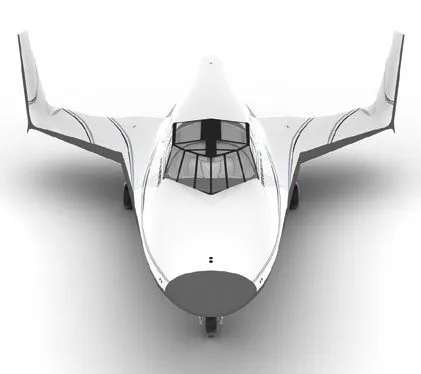
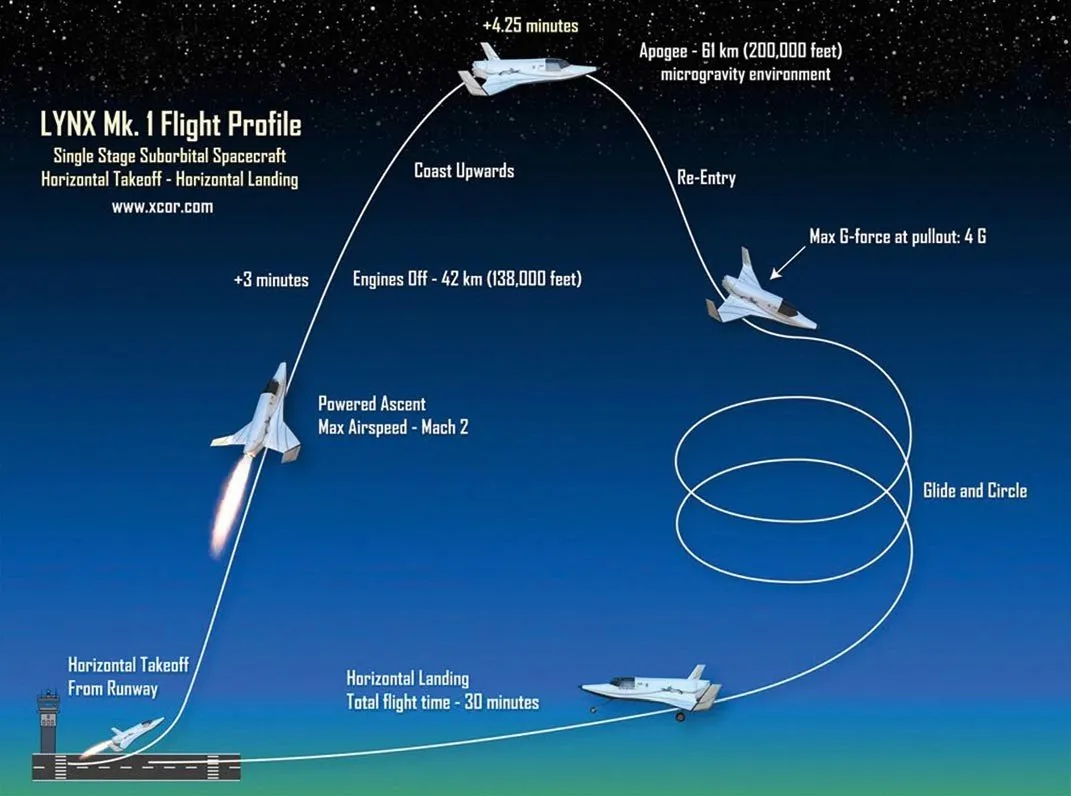
The Lynx is projected to carry one pilot, a ticketed passenger, and/or a payload or small satellites above 100 km altitude. It is projected to fly up to four times a day from a conventional space runway.
Lynx is also the first reusable launch vehicle which has low cost operations and maintenance. Lynx has an all-composite airframe that makes it lightweight and strong. With an added thermal protection system (TPS) on the nose and leading edges it is able to handle the heat of re-entry from the edge of space.
The wing area is sized for landing at moderate touchdown speeds near 90 knots. In length, the Lynx is about 9 meters (~30 feet) with a double-delta wing that spans about 7.5 meters (~24 feet). All Lynx models are designed specifically with commercial space flights in mind.
Watchmaker Luminox also recently announced a partnership with SXC to provide special timepieces for the firm’s space tourists. The watches are being developed to withstand the G-forces that will be encountered during the flight. XCOR and SXC together have taken over 175 reservations from clients eager to launch aboard the Lynx spacecraft.
How much will a ride cost? A ride aboard Lynx will retail at ₹51,66,163, company officials said, which includes the cost of pre-flight training sessions to prepare passengers for the experience.
8 facts about Buzz Aldrin
- The nickname “Buzz” came from the way his sister said the word buzzer instead of brother.
- As a fighter pilot in the Korean War, he completed 66 F-86 combat missions, destroyed two MiGs, damaged another, and earned the Distinguished Flying Cross.
- His doctoral dissertation at M.I.T. dealt with the piloting and rendezvous of two spacecraft in orbit. Aldrin’s techniques have been used on many NASA missions.
- He logged 289 hours and 53 minutes in space between the Gemini and Apollo programs.
- He is the author of nine books, including two novels, and his new book Mission to Mars is all set to be launched this summer.
- 1969: Receives the Presidential Medal of Freedom from President Richard Nixon.
- 1993: Patents his design for a permanent space station.
- March 19, 1993: Is inducted into the Astronauts Hall of Fame.
From the April 2013 issue of FHM India.
Spotted a mistake, or your photo used without permission? Report a correction













 in your inbox