
A Man’s Guide To Essential World Cinema
Found yourself drawn to the hot girl who almost exclusively watches world cinema? Twelve films and the lingo to fib your way into the snootiest of movie circles.
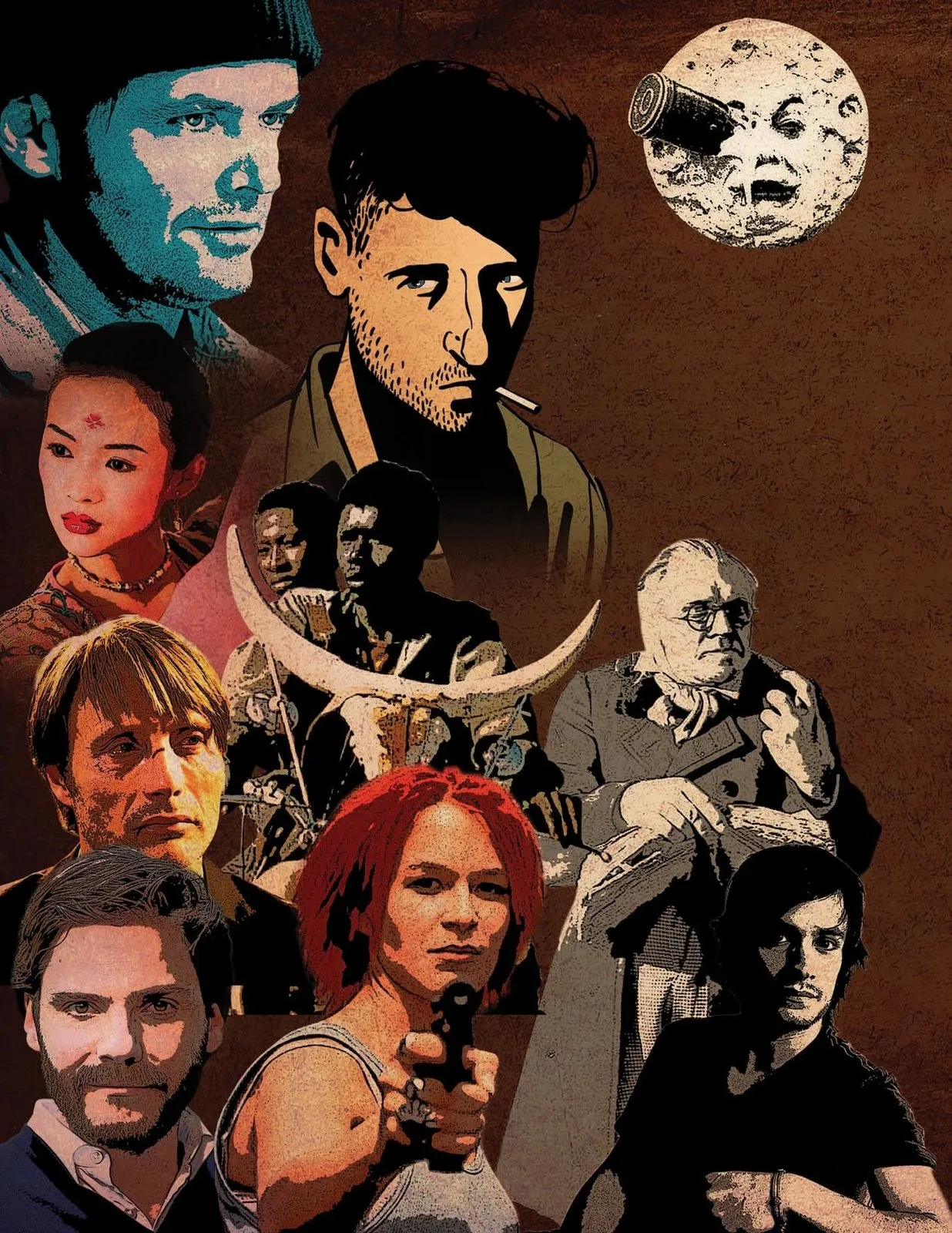



Found yourself drawn to that amazingly hot girl in the Fab India kurta who almost exclusively watches World Cinema and scoffs when you mention Happy New Year? Here’s some expert help so you can fib your way into the snootiest of movie circles.
A Trip to the Moon (1902), France
First film in the world to feature a plot with science fiction, space travel and graphic animations, it is a light hearted criticism of the conservative scientific society of that time. A group of astronomers are catapulted to moon on a space capsule, landing right in the eye of the moon. Strange things follow with dreams of stars and planets, snowstorms, Selenites (people of Moon), and finally an escape back to Earth. This almost 13-minute long film is among the 500 productions by director Georges Melies, the pioneer of French, and to an extent, world cinema. Its b/w poster of a space capsule in the Moon’s eye remains the most iconic and frequently referenced image in the history of cinema.

Kickass Brownie Point: It was the first movie to be pirated (in the US).
The Cabinet of Dr. Caligari (1920), Germany
A rare blend of lowbrow entertainment and a pervasive sense of dread, this is the first horror film in the history of silent cinema, and enjoys a whopping 100% rating on Rotten Tomatoes. Francis (Friedrich Feher) narrates a surreal story to a stranger, in flashback, about a certain Dr. Caligari (Werner Krauss). He exhibits a sleep-walker inside a coffin-like cabinet, who predicts the future of anyone that approaches him. What follows is a series of murders in the county. The USP is a brilliant twist ending, another first in the world of cinema.
Kickass Brownie Point: It comes across as an obvious inspiration for Shutter Island
Pather Panchali (1955), India
This was Indian cinema’s debut among the elite international film fraternity, and laid the foundation stone of parallel cinema in India. Director Satyajit Ray was so impressed with Italian classic Bicycle Thieves that he heavily drew his inspiration from. It is the first part of the Apu Trilogy, a film series that closely moves with the growing up of Apu, the protagonist. The pivot remains a simplistic rural life of the extremely poor, without letting it droop in a tragic pool, more truly romanticising it, in fact. The film was shot mostly on location, rather than in a studio and most actors were amateurs.
Kickass Brownie Point: The film never had a complete screenplay. The cast took most of their cues from Ray’s drawings and notes.
Touki Bouki (1973), Senegal
This film breaks free of the poverty ridden impression of an African film. It is the story of Mory, a young motorcycle riding herdsman, involved in petty crimes in Dakar to raise enough money to flee to Paris with his girlfriend. Mory is a rebel, fuelled by a hunger for money and dreams of a false paradise. It experiments with new styles in filmmaking, and creates a style of its own through jump cuts and an overlapping of pastoral and modern sounds in the background.
Kickass Brownie Point: Mory’s motorcycle is mounted with a bull horn skull, symbolising his pride. How kickass is that!
One Flew Over the Cuckoo’s Nest (1975), USA
Jack Nicholson’s free spirit and badass personality in real life is reflected in this time-tested academy award winning film inside a mental asylum. McMurphy (Nicholson) is transferred to a mental institution for evaluation for having committed statutory rape of a 15 year old girl, although he shows no sign of any mental illness. The story reaches a turning point when he gets involved with other inmates and stands for them against the unyielding nurse Ratched (Louise Fletcher), the symbol of dominance. It is among the only three, so far, that succeeded in winning all five major Academy Awards, including best actor, best actress, best picture, best director and best screenplay.
Kickass Brownie Point: The role of McMurphy was originally offered to Marlon Brando.
Once Were Warriors (1994), New Zealand
If you have read ‘Commando’ comics as a kid, the word Maori is sure to ring a bell, but for those who haven’t it is a native inhabitant of New Zealand, before the whites colonised it. This film is a Maori story in modern New Zealand, exhibiting the struggle in a white world, in subverted tones. On the foreground is a brutal, alcoholic family man, at his worst, so busy in his life that by the time he notices warning signs from his daughter, it is too late.
Kickass Brownie Point: Voted the best New Zealand film of all time by a national survey
Festen (1998), Denmark
For all film connoisseurs, if you’re not already aware of Dogme95, let this be your initiation into a cult movement. Handheld cameras, pure on-location sounds with no post-production sound editing, shooting done on location only, and some more elaborate but strict rules mark the Dogme95. A family gathers to celebrate their father’s 60th birthday. Dinner turns into a slander ground where son accuses him of having sexually molested him and his twin sisters as kids.
Kickass Brownie Point: The film was shot on a Sony DCR-PC3 Handycam on standard Mini-DV cassettes.
Run Lola Run (1998), Germany
Parallel timelines, alternate consequences and digital surprises. The film offers so much so quickly that you’d hardly have time or patience to order that pizza you’d planned. Lola gets a phone call from her boyfriend, Manni, a criminal, about losing a bag full of 100,000 Deutsche Marks. He’s supposed to repay that amount to a gangster or he’d be killed. Lola runs to arrange for that money. Not once, but thrice, in three alternate versions slightly different from each other in consequence, with crazy flash forwards all through. Manni does his share of running too, but it’s Lola’s marathon we tuned in to see after all. And oh! She just has 20 minutes.
Kickass Brownie Point: Franka Potente (Lola) could not wash her hair for seven weeks as the red colour in her hair was very sensitive and could have lightened a shade if she did.
Good Bye, Lenin! (2003), Germany
The Berlin wall fell and, not that we cared much in India, everything changed in the world. This tragicomedy swears by the misery of Alex (Daniel Bruhl) who has to maintain the illusion for his old mother that Germany is still divided, and they still live in East Germany. Else? The mother would go back to the long sleep of coma that she woke up from after 9 months, following a routine protest rally.
Kickass Brownie Point: It’s loosely inspired by Stalin actually putting up a similar farce for Lenin, to avoid a shock.
House of Flying Daggers (2004), China
To quench almost all our fetishes and fantasies comes a movie with a gorgeous Chinese beauty, sandwiched between kickass fight sequences and a love story, stained in blood. A rebellious group steals from the rich and gives to the poor. But the cruel king must stop them. Action starts when love knocks out the call of duty.
Kickass Brownie Point: It received a 20-minute standing ovation at its Cannes Film Festival premiere.
Waltz with Bashir (2008), Israel
This is the first full length, animated war documentary to be nominated for the Academy Awards and a Golden Globe Award for Best Foreign Language Film category. It is the retelling of history through the memory of Lebanon war of 1982. The film was made with a combination of Adobe Flash cutouts and classic animation, using over 2,300 original illustrations.
Kickass Brownie Point: David Polonski did most of the illustrations with his left hand, as he thought his original drawings were ‘too pretty’.
No (2012), Chile
When politics, rigged elections and regime change meet the world of advertising, stakes soar a little too high to be ignored anymore. Set in the 1980’s decisive corner of Chile, where dictator Gen. Augusto Pinochet’s de facto Presidential status is subject to public voting under a government plebiscite. The opposite side is anonymously called ‘No’ that hires a young successful ad man, Rene Saavedra (Gael Garcia Bernal) to lead the campaign against Pinochet. The film offers gusts of adrenaline with strategies and standing-up-against-the-militaryregime guts of a smart young generation.
Kickass Brownie Point: Gael Garcia Bernal also played the badass Ernesto ‘Che’ Guevara, in the film Motorcycle Diaries.
Lingo to drop
- Dolly: A set of wheels and a platform upon which the camera is mounted, for mobility.
- Rack focus: Technique to shift focus from foreground to background and vice versa, for emphasis.
- Jump cut: An abrupt cut between two shots where there is no seeming match between the scenes.
- Wipe: An optical effect in which an image appears to push aside the preceding image.
- Martini shot: The very last shot in production for that day, while shooting a film.
- ADR: Automatic Dialogue Replacement. Recording dialogues separately from the action of the scene.
- Closed set: Means there is a nude scene being shot. Selective people are allowed inside.
From the November 2014 issue of FHM India.
Spotted a mistake, or your photo used without permission? Report a correction








 in your inbox