
Food Myths: Busted!
Everything you ever wanted to know about grub but were too hungry to ask: chewing gum, beans, the five-second rule, cheese dreams, oysters, sell-by dates, fortune cookies, asparagus, shrinking chocolate bars, GM food and celery.
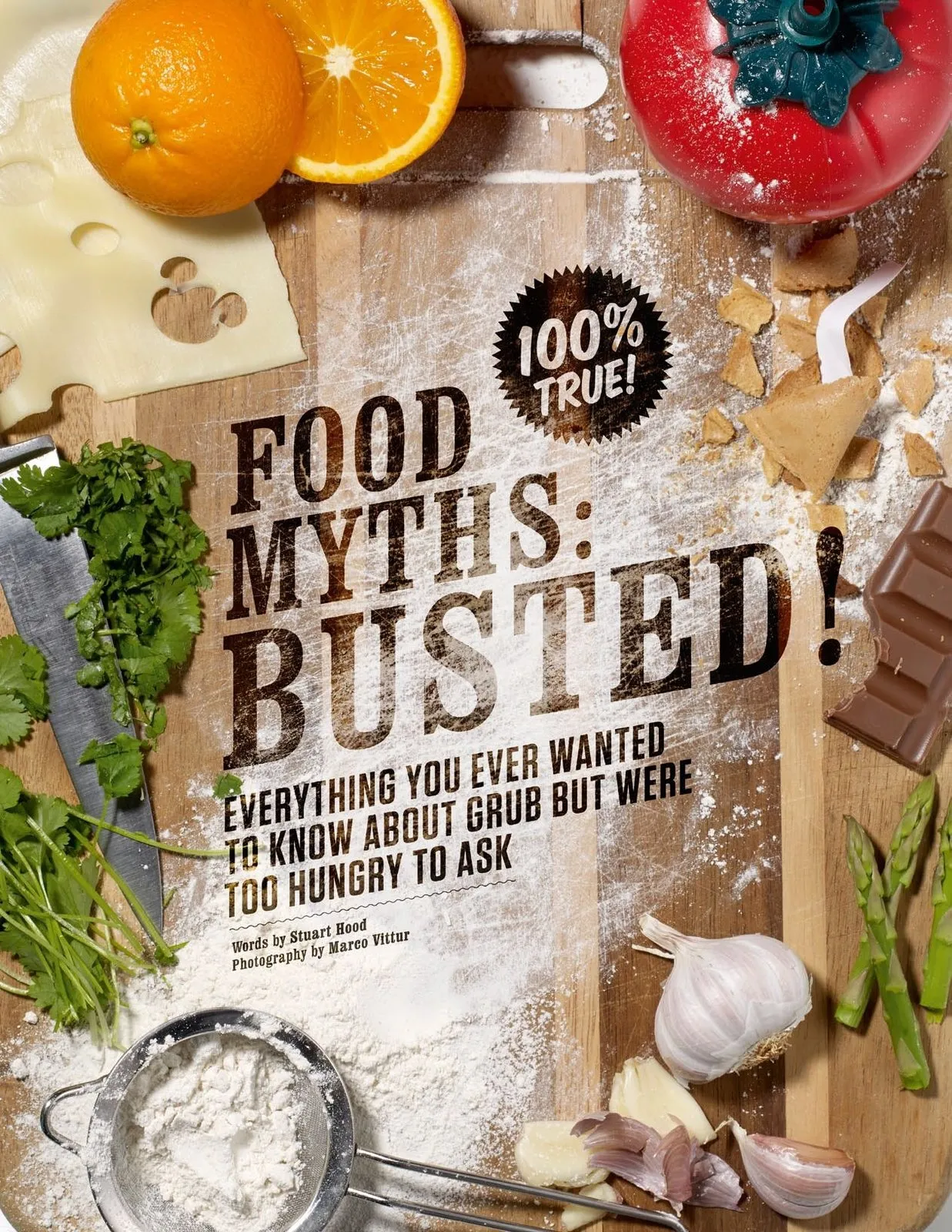



If fad-diet salesmen and excitable headline writers are to be believed, pretty much everything you put in your mouth – from a simple slice of cheese to an innocent tin of beans – will make you fat, give you cancer or come to life, bite you and kick you in the shins. Add this to the wealth of “scientific” information flying around and making healthy food choices has become a stomach-churning minefield. Which is why FHM has pulled on its lab coat and set out to sort foody fact from foody fiction. Settle in as we answer the culinary questions that really matter.


Chewing gum stays in your system for seven years
The theory: This actually happened to someone at our brother’s mate’s cousin’s school, honest! Swallow some chewing gum and it’ll remain in your gut until 2020.

The facts: “This is completely bogus,” says Professor Terence Cosgrove, a chemistry lecturer who invented Revolymer “easy to remove” chewing gum. “It just goes right through your system and is not digested in any way. The danger comes if you swallow 20 or 30 pieces a day. Do that and the doctor will need a drill to get it out.”
Food myth!
Beans mean excessive gas
The theory: Beans, beans, the musical fruit, the more you eat, the more you toot. Sure, it rhymes, but is it true?
The facts: “When certain foods such as beans and cabbage are broken down by bacteria in your large bowel, they form gas,” explains Dr Sneh Khemka. “Also, beans are a great source of soluble fibre, which isn’t broken down until it reaches your large intestine, and this can cause further gas to form.”
Food truth!
People in China and Korea eat dogs for dinner
The facts: According to the animal-rights group In Defense of Animals, more than two-and-a-half million South Korean dogs are killed each year as part of the $2 billion dog-and-cat-meat industry. And according to Lonely Planet’s China editor Damian Harper, “You see dog meat quite a bit in China, but it’s not everywhere. You don’t find it at all in Hong Kong, for example. It is, however, pretty popular in Guangxi [south-west China] and parts of Guangdong. Dog meat appears in all forms: fried, boiled, in hot pots, in dumplings, in soup, spicy, hot and sour – you name it, they cook it.”
Food truth!
Dropped food remains germ-free if you pick it up within five seconds
The theory: Drunkenly dropped your takeaway on the kebab shop floor? Don’t panic – as long as you blow off the dust, pick off the hairs and give it a quick wipe within five seconds, you’re good to go.
The facts: “The moment your food falls, bacteria, hair and other muck will stick straight on it,” says environmental health officer Sarah Daniels. “If you drop a steak at home you could chance it, but if your dog brought muck into your kitchen, that could be on your steak. The pavement is even worse. It’s covered in faecal bacteria and nastiness.”
Food myth!
Cheese before bed gives you weird dreams
The theory: That recurring nightmare where you’re drowning in a giant bowl of molten marshmallows? Must’ve been that trip-inducing Double Gloucester you snacked on.
The facts: The Dairy Council claims Stilton causes the most vivid dreams and Red Leicester prompts night-time nostalgia. But Dr Chris Idzikowski of the Edinburgh Sleep Centre says this is tosh. “There have been no worthwhile experiments into this and neuropharmacological explanations are too far-fetched for this to be true,” he argues. Cheese toasties before bedtime, anyone?
Food myth!
Fat makes you fat
The theory: Fat-laden food turns you into Chubblethorpe McManboobs. They call it “fat” for a reason.
The facts: “There are two main types of fat – saturated, which is bad, and unsaturated, which isn’t,” says Dr Sneh Khemka. “Eat too much saturated fat and you’re more likely to be overweight and suffer from high cholesterol, which increases your chance of developing heart disease. Because of this, the average man should have no more than 30g of saturated fat a day.” But unsaturated fat is actually healthy. “Good unsaturated options include oily fish, avocados, nuts and seeds.”
Food myth!
Oysters make you horny
The theory: Something this slimy and cripplingly expensive must have at least one redeeming quality. Who needs Viagra when you’ve got a plateful of these shell-based treats?
The facts: “There’s no scientific proof of this,” says Amy Levine, sex coach and founder of igniteyourpleasure.com. “But oysters are high in zinc, which is said to boost sexual desire, and Casanova supposedly consumed them before trysts. My view is that they have a placebo effect – believe and it will do its magic, so to speak.” Basically, if you think you’re going to stay up all night with a beautiful woman, then you will. (That’s how it works, right?)
Food myth!
You can ignore the sell-by date if your food smells OK
The theory: Food labels are more just guidelines, really. Proper men use the sniff test.
The facts: “Smelling out-of-date food works for spoilage bacteria, but you cannot smell salmonella, so it could be all over your food and your nose would have no idea,” says environmental health officer Sarah Daniels. “I’d also recommend not eating food after the ‘consume within’ window. Most supermarket food is packaged in nitrogen-rich air, because this modified air doesn’t have any oxygen and bacteria needs oxygen to grow. As soon as we open a packet or carton, however, oxygen pours in and bacteria multiplies at will, making ‘consume within’ dates crucial.”
Food myth!
Fortune cookies come from China
The theory: A long, long time ago, in a Chinese kitchen far, far away – well, in China – someone came up with the idea of encasing a soothsaying scrap of paper inside a crispy post-dinner snack.
The facts: “Fortune cookies were originally Japanese senbei [rice crackers] sold in confectionery shops in San Francisco’s Japan Town from the 1920s,” explains food writer and historian Rachel Laudan. “But when the Japanese living in the States were interned during the second world war, they had to leave their senbei-making machines behind. Ta-dah! By the end of the war, fortune cookies were Chinese.”
Food myth!
Asparagus makes your pee smell funny
The theory: Scoff a stick of asparagus and your trips to the toilet will produce a funky aroma. OK, a funkier aroma.
The facts: “It’s a very pungent, acrid smell,” says Dr Malcolm VandenBurg, a consultant pharmaceutical physician. “It is nothing to worry about, though. The body simply extracts chemicals from the asparagus, changes them slightly, and then excretes them via the urine in a form that smells pungently.”
Food truth!
Chocolate bars are getting smaller
The theory: What’s going on? Either our hands are getting bigger or we’re being royally done over by the confectionery conglomerates.
The facts: We’re being done over. Last October, Britain’s Office of National Statistics revealed that Dairy Milks had shrunk from 49g to 45g. “Shrinking products is an underhand way of inflating prices because pack sizes shrink but the prices don’t,” explains a Which? spokesperson.
Food truth!
Genetically modified food will turn you into a mutant
The theory: Munch on those lab-produced noms and it’ll be a matter of weeks before you turn into that three-eyed fish off of The Simpsons.
The facts: “We have seen an increasing number of studies that indicate signs of ill health from the consumption of GM food,” says Dr Michael Antoniou, a molecular geneticist and GM expert. “The most recent was completed by Professor Gilles-Eric Séralini, who completed a two-year feeding study in rats. He found signs of serious liver and kidney damage and a number of tumours. The next step should be to complete a similar study with more animals. Until this happens, consumers should be wary of GM foods.”
Jury’s out!
Celery has negative calories
The theory: The jaw action required to chomp down celery expends more calories than are contained within the rabbit food, so the more you eat, the thinner you get!
The facts: “No evidence backs this up,” says nutritionist Drew Price. “However, the number of calories we’re talking about – either gained or lost – is so tiny, it’s just not an issue.”
Food myth!
From the May 2013 issue of FHM India.
Spotted a mistake, or your photo used without permission? Report a correction













 in your inbox